venerdì 25 maggio 2012

Nuclear Famine: A Billion People at Risk

Scientists Spotlight Nuclear Famine Perils

5/25/2012
By Ernest Corea*
IDN-InDepth NewsAnalysis
WASHINGTON (IDN) – Support for nuclear disarmament and non-proliferation suffered a set-back when Republican Senator Richard Lugar was defeated at a pre-election primary (May 8 ) in the state of Indiana. He was eliminated by a tea party supported contender, and will not be the Republican Party candidate for the Senate in November. Lugar has announced, as well, that he will not run as an Independent.
This removes from the federal legislature a widely recognized and respected legislative activist on nuclear disarmament related issues that most of his colleagues would prefer to tuck under their mattresses and forget. Among them: a timely caution on the serious risk of nuclear famine.
Lesser beings are now left to focus on and bring good sense into decisions that impinge on security, stability, and survival.
Nuclear Alert
Issues high on the international agenda include consideration of NATO’s Deterrence and Defence Posture Review, and the attempt in the US House of Representatives to adopt legislation that would restrict implementation of the new START agreement.
On top of all that, comes a new report which presents and analyses scientific evidence, to show that even a regional nuclear war – conflict between India and Pakistan is the example cited – could cause massive disruption of agriculture producing countries far removed from the theatre of war. As always in such circumstances, the poor would be the most harmed.
The countries directly involved would obviously suffer directly and widely, and their painstakingly nurtured agricultural productivity would be lost, their crops and crop lands turned into radioactive dust. The warning now is that, in addition to direct results felt by nuclear combatants, repercussions would be felt elsewhere, too, with some major food producers hit hard.
The report, Nuclear Famine: A Billion People at Risk – Global Impact of Limited Nuclear War on Agriculture, Food Supplies, and Human Nutrition – was published by International Physicians for the Prevention of Nuclear War and its US affiliate, Physicians for Social Responsibility.
(International Physicians for the Prevention of Nuclear War is a non-partisan federation of national medical organisations in 63 countries who share the common goal of creating a more peaceful and secure world freed from the threat of nuclear annihilation. Physicians for Social Responsibility is the largest physician-led organization in the U.S. working to prevent nuclear war and proliferation and to slow, stop and reverse global warming. Dr. Ira Helfand, author of the report, is the North American vice president of the International Physicians for the Prevention of Nuclear War and a past president of Physicians for Social Responsibility.)
Says Helfand: “The grim prospect of nuclear famine requires a fundamental change in our thinking about nuclear weapons. The new evidence that even relatively small nuclear arsenals of countries such as India and Pakistan could cause long lasting, global damage to the Earth’s ecosystems and threaten hundreds of millions of malnourished people over a decade would be a disaster unprecedented in human history.”
The credentials of the author and of the institutions associated with the report, as well as its substance, make the report compelling. So, consider then, the world’s current state of food security or, as the UN Food and Agriculture Organisation (FAO) likes to put it, insecurity.
Food Insecurity
Food insecurity is generally beset by unpredictable conditions, more so in some years than in others, with the threats to human health and lives unevenly spread across the rich and poor countries of the world. Thus, approaches to issues that affect or are affected by food security and insecurity vary greatly. Where the wealthier nations grapple with the health risks of obesity, people in poor countries confront the challenges of hunger, and hidden hunger – malnutrition.
In addition, weather patterns including early signs of climate change, productivity, production, infrastructure, skewed trade practices, and investment all have a direct or indirect impact on food insecurity.
In 2011, the last year for which complete statistics are available, the world was not affected by the kind of crisis it experienced in 2006-2008. The aftermath of what was experience at that time are, however, “challenging our efforts to achieve the Millennium Development Goal (MDG) of reducing the proportion of people who suffer from hunger by half in 2015″ say the heads of the three food-related agencies headquartered in Rome. FAO, IFAD (International Fund for Agricultural Development) and WFP, (the World Food Program).
They added the caution that “even if the MDG were achieved by 2015 some 600 million people in developing countries suffering from hunger on a daily basis is never acceptable.”
If extended food insecurity is already considered unacceptable, how should the international community respond to the greater danger of nuclear war-induced famine?
One Billion at Risk
Helfand and a team of experts in agriculture and nutrition worked with data produced by scientists who have studied the effects on climate of a hypothetical nuclear war between India and Pakistan. They determined, says Physicians for Social Responsibility, that “plunging temperatures and reduced precipitation in critical farming regions, caused by soot and smoke lofted into the atmosphere by multiple nuclear explosions, would interfere with crop production and affect food availability and prices worldwide.”
In specific terms, a PSR statement points out, Helmland and his associates found that:
–In the US, corn (maize) production would decline by an average of 10 percent for an entire decade, with the most severe decline (20 percent) in fifth year. Soybean production would decline by about 7 percent, with the most severe loss, more than 20 percent, in the fifth year.
–China would experience a significant decline in middle-season rice production. During the first four years, rice production would decline by an average of 21 percent; over the next six years the decline would average 10 percent.
–Resulting increases in food prices would make food inaccessible to hundreds of millions of the world’s poorest.
There is little left for the imagination, in this stark assessment, considering the fact that China and the US are the leading producers of those commodities.
The report itself states:
“The 925 million people in the world who are chronically malnourished have a baseline consumption of 1750 calories or less per day. Even a 10 percent decline in their food consumption would put this entire group at risk.
“In addition the anticipated suspension of exports from grain growing countries would threaten the food supplies of several hundred million additional people who have adequate nutrition today, but who live in countries that are highly dependent on food imports. The number of people threatened by nuclear war-induced famine would be well over one billion.”
The late S. Rajaratnam, Singapore’s eloquent foreign minister and prescient political strategist, would say that “man does not live by bread alone but without bread he does not live at all.” This is lightly stated but heavy in significance.
Agriculture lies at the core of development and of continued progress even in industrialised countries. That’s why it is fair to say that a breakdown of food production and distribution in the dimensions spelled out by Helfland and his colleagues would result in unimaginable human suffering – over time, deaths – and eventually, in societal collapse across many countries that were not involved in the hypothetical regional conflict.
Consider This
The quick and easy response to the alert that has been sounded would go something like this: “Yes, the danger exists, but only if India and Pakistan actually engage in a nuclear war. They have unfortunately turned the sub-continent into a nuclear neighborhood but have exercised restraint and responsibility in not plunging the region into nuclear destruction. What is needed is for the international community to use all the leverage it can muster, to help both countries remain at peace.”
Sure, but what is to prevent a militarized regime some day in the future from discarding the bonds of restraint? Besides, India and Pakistan are not the world’s only regional powers with nuclear capacity. Israel, for instance, is widely believed to be a nuclear state. Others aspire to the same status in a volatile part of the world.
Efforts to persuade Middle East nations to talk to each other about keeping their region free of nuclear danger have fallen on politically deaf ears that have not been supplied with hearing aids. A preliminary regional conference scheduled for December 2012 is likely to be postponed.
The real safeguard against nuclear famine has to come not from some hit-or-miss “let’s all keep the peace” process, with soothing songs warbled around a campfire, but with renewed international commitment to nuclear disarmament.
Jayantha Dhanapala, a Sri Lankan diplomat who was the UN Under Secretary General for Disarmament and is currently president of the Pugwash Conference on Science and World Affairs, has spent much of his professional life beating out the message of nuclear disarmament. He sums up the situation succinctly:
“Scientific evidence continues to confirm empirically what we already know – that nuclear weapons are the most destructive weapon of mass destruction ever invented with unrivaled genetic and ecological effects. And yet, unlike biological and chemical weapons they have not been outlawed because of vested interests.
“Nine countries have 20,530 nuclear warheads among them, 95 percent with the US and Russia. As long as these weapons exist others, including terrorists, will want them. As long as we have nuclear weapons their use by intention or accident; by states or by non-state actors is inevitable. Their total elimination through a Nuclear Weapons Convention is therefore the only solution.”
A tough sell? Indeed. But consider this: what an outstanding outcome awaits the sale. [IDN-InDepthNews – May 19, 2012]
*The writer has served as Sri Lanka’s ambassador to Canada, Cuba, Mexico, and the USA. He was Chairman of the Commonwealth Select Committee on the media and development, Editor of the Ceylon ‘Daily News’ and the Ceylon ‘Observer’, and was for a time Features Editor and Foreign Affairs columnist of the Singapore ‘Straits Times’. He is Global Editor of IDN-InDepthNews and a member of its editorial board as well as President of the Media Task Force of Global Cooperation Council.

mercoledì 23 maggio 2012

L’intero emisfero settentrionale sembra perduto


Fukushima: “L’intero emisfero settentrionale sembra perduto”


Ad oltre un anno dal disastro nucleare aumentano le preoccupazioni su quel che potrebbe ancora accadere nella centrale nucleare.
L’instabilità della piscina di raffreddamento del reattore 4, dove il combustibile esaurito ha 10 volte più cesio-137 radioattivo di quello scaricato nell’atmosfera dalla tragedia nucleare di Chernobyl nel 1986, è preoccupante. Alla fine del 2011 il governo giapponese aveva annunciato che i liquidatori della Tokyo electric power company (Tepco) erano riusciti ad ottenere l’arresto a freddo dei tre reattori danneggiati, ma i bacini di stoccaggio delle scorie sono ancora a rischio e questo significa che la crisi nucleare è ancora lontana dall’essere conclusa.  Il sistema di raffreddamento serve ad impedire la fusione del materiale radiattivo costituito dal combustibile esaurito. Quando il 15 marzo è scoppiato l’incendio nel reattore n. 4, anche se spento, il guasto all’impianto di raffreddamento ha impedito di contenere il surriscaldamento dovuto al decadimento naturale del combustibile nucleare, e questo ha portato alla vaporizzazione dell’acqua della piscina di soppressione in cui è immerso il reattore e alla successiva reazione tra vapore bollente e lo zirconio che riveste le barre di combustibile. Per contenere il surriscaldamento è stato autorizzato il rilascio controllato di vapore e si è proceduto all’irrorazione dei reattori con acqua di mare e acido borico riversando così un’immensa quantità di radiazioni nell’atmosfera e nell’acqua che si è riversata nell’oceano.
Nell’articolo precedente si è spiegato come anche il reattore 1 versa in gravi condizioni. Se l’acqua della piscina di raffreddamento dovesse finire si potrebbe andare incontro ad un effetto a catena di fuoco radioattivo altamente tossico che potrebbe portare secondo alcuni alla famosa “sindrome cinese” in cui il nucleo fuso di una centrale continua a fondere fino al nucleo terrestre. Di fatto nessuno, se non i dipendenti Tepco, è ammesso da mesi vicino al reattore 1, dove chiunque muore nel giro di due minuti e mezzo a causa di avvelenamento acuto da radiazioni nonostante tutte le protezioni del caso.
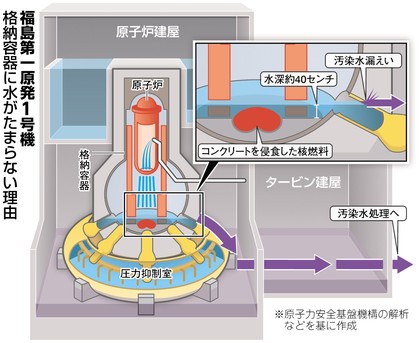
Proprio oggi sul sito http://fukushima-diary.com è stato pubblicato un articolo che afferma come la situazione del reattore 1 stia peggiorando dato che il livello della piscina del reattore 1 è di soli 40cm.
Riporto l’articolo tradotto da Giorgio per Dioni che ringrazio:
“Era 60cm nel reattore 2, ma è ancora peggio nel reattore 1.
L’organizzazione per la sicurezza dell’energia nucleare ha analizzato il livello dell’acqua dal punto in cui viene iniettato l’azoto nel PCV (Pressure Containment Vessel, si tratta del contenitore a pressione) del reattore numero 2 e della pressione dell’aria. Il risultato è che, al ritmo di 6 tonnellate d’acqua iniettate ogni ora, il livello dell’acqua è solo 40cm dal fondo del contenitore.
I tubi che collegano il PCV con la sala contenente il torio presentano dei buchi di svariati cm di diametro. Tutta l’acqua iniettata fuoriesce dai buchi e si riversa nel piano seminterrato dell’edificio del reattore e si allarga all’edificio delle turbine situato accanto al reattore.
Lo spessore del PCV è di 30mm, ma i tubi che lo collegano alla camera toroidale sono solo 7,5 millimetri di spessore. Le stime della TEPCO sul livello dell’acqua erano di 1,8m ma, come sempre, esse si sono rivelate errate.
La TEPCO prevede operazioni di endoscopia per rilevare la temperatura all’interno del PCV entro la fine dell’anno.”
Lo stesso sito in un articolo mostra una foto scattata ieri 21 maggio, a più di un anno dalla catastrofe, alla stazione Motomiya situata a 57KM di distanza dagli impianti nucleari di Fukushima. Una madre con il figlio. E’ una bella immagine ma immersa in un ambiente radioattivo di 0.36μSv/h. ”Spero che il piccolo sia al sicuro. Dopo aver scattato la foto, la quantità di radiazioni rilevate è salita a 0.40μSv/h.“
Per un confronto, il livello normale (o livello di fondo naturale o livello di radiazione ambientale) è inferiore a 0,1 µSv/h (dell’ordine di da 0,03 a 0,06 µSv/h), quindi 6 volte superiore alla norma!
Sempre nello stesso articolo un lettore tedesco (@toba) commenta: “Ieri anche 0.6 uSv/h nella pioggia a Stoccarda in Germania. L’intero emisfero settentrionale sembra perduto…”
In Italia oggi 22 Maggio era circa 0.18 uSv/h, quindi ancora superiore alla norma.
Dobbiamo sapere quello che sta accadendo, non possono negarci la verità.
Nessuno ha aiutato il Giappone, anzi la TEPCO ha riferito che non ha abbastanza soldi per affrontare il problema.
In una petizione congiunta Alle Nazioni Uniti affinchè aiutino il Giappone e il Pianeta (“to the United Nations to help Japan and the planet”) inviata nei giorni scorsi al segretari generale dell’Onu Ban Ki-moon da esperti nucleari statunitensi e giapponesi come Arnie Gundersen, Robert Alvarez, Hiroaki Koide, Masashi Goto e  da Mitsuhei Murata, ex ambasciatore giapponese in Svizzera, da Akio Matsumura,un ex diplomatico Onu  e da 73 Ong giapponesi si legge: «Quasi tutti i 10.893 spent fuel assemblies dell’impianto di Fukushima Daiichi sono in piscine vulnerabili ai futuri terremoti,  con  livelli di longevità di circa 85 volte più lunghi rispetto a quella rilasciata a Chernobyl».Gli esperti e le Ong ricordano a Ban di aver sempre messo in guardia il governo di Tokyo e l’International atomic energy agency «Contro l’alto rischio della piscina del combustibile nucleare esaurito dell’unità 4 di Fukushima». Il senatore statunitense Roy Wyden, dopo la sua visita alla centrale nucleare di Fukushima Daiichi il 6 aprile scorso, in un comunicato stampa sottolineava «Il rischio catastrofico dell’unità 4 di Fukushima Daiich, chiedendo un intervento urgente del governo Usa ed ha anche inviato una lettera ad Ichiro Fujisaki, ambasciatore del Giappone negli Usa, chiedendo il Giappone di accettare l’aiuto internazionale per affrontare la crisi».
Nella petizione a Ban Ki-moon si legge: «Noi le organizzazioni civili giapponesi esprimiamo la nostra più profonda preoccupazione perché il nostro governo non informa i cittadini riguardo all’entità del rischio  della piscina del combustibile nucleare esaurito dell’unità 4 di Fukushima Daiichi. Tenuto conto del fatto che il crollo di questa piscina potrebbe portare a conseguenze potenzialmente catastrofiche che hanno implicazioni a livello mondiale, quello che il governo giapponese dovrebbero fare come un membro responsabile della comunità internazionale è di evitare qualsiasi ulteriore disastro attraverso la mobilitazione di tutta la conoscenza e i mezzi a disposizione, al fine di stabilizzare questo combustibile nucleare esaurito. E’ evidente che la piscina del combustibile nucleare esaurito dell’unità 4 di Fukushima Daiichi non è più un problema giapponese, ma un problema internazionale con conseguenze potenzialmente gravi. Pertanto, è imperativo per il governo giapponese e la comunità internazionale lavorare insieme su questa crisi prima che sia troppo tardi. Ci appelliamo alle Nazioni Unite perché aiutino il Giappone e il pianeta a prevenire le conseguenze irreversibili di una catastrofe che potrebbe influenzare le generazioni a venire».
Di fronte alla possibilità di un’altra catastrofe, il governo giapponese sembra comportarsi come durante il disastro nucleare del 2011: negare il problema e minimizzare rischi.
Ma l’opinione pubblica giapponese, esperti e politici vedono ormai un intervento tecnico-scientifico internazionale come l’unica possibilità di evitare un nuovo disastro. Le 72 Ong giapponesi chiedono all’Onu: 1. Le Nazioni Unite dovrebbe organizzare un vertice per la Sicurezza Nucleare che assuma il problema cruciale della piscina del combustibile nucleare esaurito dell’unità 4 di Fukushima Daiichi. 2. Le Nazioni Unite dovrebbero istituire un team indipendente di valutazione relativo  all’unità 4 di Fukushima Daiichi e coordinare l’assistenza internazionale al fine di stabilizzare il combustibile nucleare esaurito dell’unità ed evitare conseguenze radiologiche, con conseguenze potenzialmente catastrofiche.
Per approfondire su quello che è successo veramente a Fukushima e ciò che sta accadendo leggete i link all’interno dell’articolo e il dossier Fukushima: la verità.


Tratto da: Fukushima: “L’intero emisfero settentrionale sembra perduto” | Informare per Resistere http://www.informarexresistere.fr/2012/05/22/fukushima-lintero-emisfero-settentrionale-sembra-perduto/#ixzz1vg3hEgFY
- Nel tempo dell'inganno universale, dire la verità è un atto rivoluzionario! 

martedì 1 maggio 2012

Il Giappone chiude col nucleare


Il Giappone chiude il 5 maggio l'ultimo reattore nucleare del paese!


ULTIMO_REATTORE_GIAPPONESETra pochi giorni il Giappone sara' privo di energia da fonte nucleare: l'ultimo reattore operativo sui 54 totali, il numero 3 di Tomari, sara' spento il 5 maggio "verso le ore 23", ha reso noto l'operatore dell'impianto, Hokkaido Electric Power (clicca qui per la fonte)
In questo modo il Giappone fa una virata di 180°, rinunciando completamente all'obiettivo di aumentare del 50% l'energia elettrica da fonte nucleare che aveva prima del disastro di Fukushima. Secondo le parole del primo ministro Yoshihiko Noda: “Ripartiremo con una pagina bianca e presenteremo entro l’estate prossima un nuovo piano energetico che arriva fino al 2030″, perché “dobbiamo creare una società basata su nuove energie. Grazie alle nostre capacità tecniche, insieme a una riforma delle leggi e a una politica di sostegno per l’adozione delle nuove energie, noi dobbiamo fare del Giappone un modello su scala globale”.
Seguiamo gli esempi di Giappone e Germania (clicca qui) che hanno ABBANDONATO COMPLETAMENTE la produzione di energia da fonte nucleare!
Diventiamo PRODUTTORI DI ENERGIA RINNOVABILE A CASA NOSTRA!
Torniamo Sovrani dell'energia

lunedì 23 aprile 2012

Fukushima réacteur 4, un danger au delà de tout


Published on Apr 22, 2012 by 
Interview du diplomate Akio Matsumura qui nous prévient que la catastrophe de la centrale nucléaire de Fukushima au Japon peut finalement se transformer en un évènement capable de mettre en péril toute vie sur Terre.

S'exprimant lors d'une audience publique de la commission budgétaire de la Chambre des Conseillers le 22 Mars 2012, l'ambassadeur Mitsuhei Murata a averti que "si le bâtiment estropié du réacteur 4 (avec 1.535 barres de combustible dans la piscine de combustible usé à 30 mètres au-dessus du sol) s'effondre, non seulement cela va provoquer l'abandon forcé des six réacteurs à cause des radiations dégagées, mais cela affectera aussi la piscine de combustible usé commune contenant 6375 barres de combustible, située à 50 mètres du réacteur 4".

Dans les deux cas, les barres radioactives ne sont pas protégés par une enceinte de confinement. Elles seront dangereusement exposées à l'air libre. Ce serait certainement provoquer une catastrophe mondiale comme nous n'en avons jamais connu. Il a souligné que la responsabilité du Japon vis-à-vis du reste du monde est incommensurable. Une telle catastrophe aurait une incidence sur nous tous pour des siècles. L'ambassadeur Murata nous a informés que le nombre total des barres de combustible irradié sur le site de Fukushima Daiichi à l'exclusion des cuves des réacteurs est de 11421.

Matsumura a ensuite questionné Robert Alvarez, ancien conseiller principal auprès du secrétaire et secrétaire adjoint à la sécurité nationale et de l'environnement au Département de l'Energie US, sur l'impact d'une telle catastrophe supplémentaire à Fukushima.

Contenir les radiations ne sera pas un mince exploit, a expliqué Mr. Alvarez. "Le combustible irradié ne peut pas être simplement soulevé dans les airs par une grue comme s'il s'agissait de fret ordinaire. Afin d'éviter l'exposition aux rayonnements sévères, les incendies et les explosions possibles, il doit être transféré en tout temps dans l'eau et dans des containers secs fortement blindés.

Il a ensuite déclaré que les 11138 assemblages de combustibles usés stockés à l'usine de Fukushima contiennent *entre autres* "134 millions de curies de césium 137, soit environ 85 fois la quantité de Cesium 137 relâché lors de l'accident de Tchernobyl, selon les estimations du Conseil National Américain sur la Radioprotection."

"Il est important pour le public de comprendre que les réacteurs qui ont été en exploitation pendant des décennies, tels que ceux sur le site de Fukushima-Daiichi, ont généré quelques-unes des plus grandes concentrations de radioactivité sur la planète", a-t-il conclu.

Matsumura admet que c'est un nombre impressionnant et difficile à comprendre. Il a écrit que 85 fois plus de césium 137 que Tchernobyl "détruirait l'environnement mondial et notre civilisation. Ce n'est pas sorcier, pas plus que ça ne concerne le débat pugilistique sur les centrales nucléaires. Il s'agit d'une question de survie de l'humanité."

Mitsuhei Murata a envoyé une lettre au Secrétaire Général des Nations Unies Ban Ki-moon. "Il n'est pas exagéré de dire que le sort du Japon et du monde entier dépend du réacteur N°4. Ceci est confirmé par les experts les plus fiables, comme le Dr. Arnie Gundersen ou le Dr. Fumiaki Koide", écrivait-il à Ki-Moon. "Le monde a été fait si fragile et vulnérable. Le rôle de l'Organisation des Nations Unies est de plus en plus vitale. Je vous souhaite la meilleure des chances dans votre noble mission."

Pas un mot encore pour savoir si cette situation s'est même imprimée sur l'écran radar des Nations Unies.

Sources : http://www.infowars.com/fukushima-reactor-4-life-on-planet-earth-in-the-balance/
Blog d'Akio Matsumura : http://akiomatsumura.com/2012/04/682.html

Vidéos originales par christopherjamescote, merci à lui pour l'autorisation de sous-titrage :
http://youtu.be/KwCfAY4iyPQ
http://youtu.be/faGyYt35MUg

Traduction et sous-titrage par mes soins,
merci à Eyael pour son aide à la transcription.

lunedì 16 aprile 2012

Japanese Plan To Evacuate 40 Million


Russia Stunned After Japanese Plan To Evacuate 40 Million Revealed

A new report circulating in the Kremlin today prepared by theForeign Ministry on the planned re-opening of talks with Japan over the disputed Kuril Islands during the next fortnight states that Russian diplomats were “stunned” after being told by their Japanese counterparts that upwards of 40 million of their peoples were in “extreme danger” of life threatening radiation poisoning and could very well likely be faced with forced evacuations away from their countries eastern most located cities… including the world’s largest one, Tokyo.
The Kuril Islands are located in Russia’s Sakhalin Oblast region and stretch approximately 1,300 km (810 miles) northeast from Hokkaidō, Japan, to Kamchatka, Russia, separating the Sea of Okhotsk from the North Pacific Ocean. There are 56 islands and many more minor rocks. It consists of Greater Kuril Ridge and Lesser Kuril Ridge, all of which were captured by Soviet Forces in the closing days of World War II from the Japanese.
The “extreme danger” facing tens of millions of the Japanese peoples is the result of the Fukushima Daiichi Nuclear Disaster that was a series of equipment failures, nuclear meltdowns, and releases of radioactive materials at the Fukushima I Nuclear Power Plant, following the Tōhoku earthquake and tsunami on 11 March 2011.
According to this report, Japanese diplomats have signaled to their Russian counterparts that the returning of the Kuril Islands to Japan is “critical” as they have no other place to resettle so many people that would, in essence, become the largest migration of human beings since the 1930’s when Soviet leader Stalin forced tens of millions to resettle Russia’s far eastern regions.
Important to note, this report continues, are that Japanese diplomats told their Russian counterparts that they were, also, “seriously considering” an offer by China to relocate tens of millions of their citizens to the Chinese mainland to inhabit what are called the “ghost cities,” built for reasons still unknown and described, in part, by London’s Daily Mail News Service in their 18 December 2010 article titled: “The Ghost Towns Of China: Amazing Satellite Images Show Cities Meant To Be Home To Millions Lying Deserted” that says:
“These amazing satellite images show sprawling cities built in remote parts of China that have been left completely abandoned, sometimes years after their construction. Elaborate public buildings and open spaces are completely unused, with the exception of a few government vehicles near communist authority offices. Some estimates put the number of empty homes at as many as 64 million, with up to 20 new cities being built every year in the country’s vast swathes of free land.”
Foreign Ministry experts in this report note that should Japan accept China’s offer, the combined power of these two Asian peoples would make them the largest super-power in human history with an economy larger than that of the United States and European Union combined and able to field a combined military force of over 200 million.
To how dire the situation is in Japan was recently articulated by Japanese diplomat Akio Matsumura who warned that the disaster at the Fukushima nuclear plant may ultimately turn into an event capable of extinguishing all life on Earth.
According to the Prison Planet News Service:
“Matsumura posted [this] startling entry on his blog following a statement made by Japan’s former ambassador to Switzerland, Mitsuhei Murata, on the situation at Fukushima.
Speaking at a public hearing of the Budgetary Committee of the House of Councilors on 22 March 2012, Murata warned that “if the crippled building of reactor unit 4 – with 1,535 fuel rods in the spent fuel pool 100 feet (30 meters) above the ground – collapses, not only will it cause a shutdown of all six reactors but will also affect the common spent fuel pool containing 6,375 fuel rods, located some 50 meters from reactor 4,” writes Matsumura.
In both cases the radioactive rods are not protected by a containment vessel; dangerously, they are open to the air. This would certainly cause a global catastrophe like we have never before experienced. He stressed that the responsibility of Japan to the rest of the world is immeasurable. Such a catastrophe would affect us all for centuries. Ambassador Murata informed us that the total numbers of the spent fuel rods at the Fukushima Daiichi site excluding the rods in the pressure vessel is 11,421.”
Disturbingly, the desperate situation facing Japan is, also, facing the United States as Russian military observersoverflying the US this week as part of the Open Skies Treaty are reporting “unprecedented” amounts of radiation in the Western regions of that country, a finding that was further confirmed by scientists with the Woods Hole Oceanographic Institute who have confirmed that a wave of highly radioactive waste is headed directly for the US west coast.
Important to note is that this new wave of Fukushima radiation headed towards the US is in addition to earlier radiation events that American scientists are now blaming for radioactive particles from Japan being detected in California kelp.
Though the news of this ongoing global catastrophe is still being heavily censored in the US, the same cannot be said about Japan, and as recently reported by the leading Japanese newspaper The Mainichi Daily News that reports:
“One of the biggest issues that we face is the possibility that the spent nuclear fuel pool of the No. 4 reactor at the stricken Fukushima No. 1 Nuclear Power Plant will collapse. This is something that experts from both within and outside Japan have pointed out since the massive quake struck. TEPCO, meanwhile, says that the situation is under control. However, not only independent experts, but also sources within the government say that it’s a grave concern.
The storage pool in the No. 4 reactor building has a total of 1,535 fuel rods, or 460 tons of nuclear fuel, in it. The 7-story building itself has suffered great damage, with the storage pool barely intact on the building’s third and fourth floors. The roof has been blown away. If the storage pool breaks and runs dry, the nuclear fuel inside will overheat and explode, causing a massive amount of radioactive substances to spread over a wide area. Both the U.S. Nuclear Regulatory Commission (NRC) and French nuclear energy company Areva have warned about this risk.
A report released in February by the Independent Investigation Commission on the Fukushima Daiichi Nuclear Accident stated that the storage pool of the plant’s No. 4 reactor has clearly been shown to be “the weakest link” in the parallel, chain-reaction crises of the nuclear disaster. The worse-case scenario drawn up by the government includes not only the collapse of the No. 4 reactor pool, but the disintegration of spent fuel rods from all the plant’s other reactors. If this were to happen, residents in the Tokyo metropolitan area would be forced to evacuate.”
Even though this crisis in Japan has been described as “a nuclear war without a war” and the US Military is being reported is now stocking up on massive amounts of anti-radiation pills in preparation for nuclear fallout, there remains no evidence at all the ordinary peoples are being warned about this danger in any way whatsoever.

Calcolatore di rischio ERR Müller — Radiobiologia avanzata / ECRR 2026

Calcolatore di rischio ERR Muller - Radiobiologia avanzata / ECRR 2026 Calcolatore di rischio ERR Muller Strumento onlin...