mercoledì 16 novembre 2011
Italian Nuclear Material: Sogin Response To Gtri Action Paper
Reference id aka Wikileaks id #183899 ?
Subject Italian Nuclear Material: Sogin Response To Gtri Action Paper
Origin Embassy Rome (Italy)
Cable time Fri, 19 Dec 2008 08:50 UTC
Classification CONFIDENTIAL
Source http://wikileaks.org/cable/2008/12/08ROME1538.html
References 08ROME1528
History First published on Thu, 1 Sep 2011 23:24 UTC
Extras ? Comments
VZCZCXRO0549
RR RUEHFL RUEHNP
DE RUEHRO #1538/01 3540850
ZNY CCCCC ZZH
R 190850Z DEC 08
FM AMEMBASSY ROME
TO RUEANFA/NRC WASHDC
RUEKJCS/SECDEF WASHDC
RHEBAAA/DEPT OF ENERGY WASHDC
RUEHC/SECSTATE WASHDC 1338
INFO RUEHFL/AMCONSUL FLORENCE 3341
RUEHMIL/AMCONSUL MILAN 9713
RUEHNP/AMCONSUL NAPLES 3507
RUEHUNV/USMISSION UNVIE VIENNA 0138
RUEHBS/USEU BRUSSELS 4712
Hide header
C O N F I D E N T I A L SECTION 01 OF 04 ROME 001538
SIPDIS
ISN/NESS FOR J. MENTZ AND D. FENSTERMACHER
E.O. 12958: DECL: 11/20/2018
TAGS: ENRG [Energy and Power], IT [Italy], KNNP [Nuclear Non-Proliferation], TPHY [Physical Sciences], TRGY [Energy Technology]
SUBJECT: ITALIAN NUCLEAR MATERIAL: SOGIN RESPONSE TO GTRI
ACTION PAPER
REF: A) ROME 1528 B) 11/26/08 PRESTON-ROBINSON E-MAIL
C) 07/03/08 STAPLES-PRESTON E-MAIL D) ROME
287 (NOTAL) E) STATE 15562 (NOTAL)
Classified By: Economic Minister Counselor Tom Delare for
reasons 1.4 (b, d).
¶1. (U) This cable is classified Confidential (Releasable to
Italy) for transmission purposes. For the purpose of
discussion with officials of the Government of Italy (GOI)
and wholly-GOI-owned entities such as the Societa Gestione
Impianti Nucleari (SOGIN), the inventory below may be
declassified and marked as "SENSITIVE PHYSICAL SECURITY
INFORMATION."
¶2. (SBU) Summary. Officials of Italian nuclear site
management firm SOGIN welcome the chance to discuss possible
disposition of Italian nuclear "gap" material through the
U.S. Department of Energy's Global Threat Reduction
Initiative (GTRI). In response to DOE's "Proposed GTRI
Action Paper for SOGIN and ENEA" (ref C), SOGIN provided an
inventory of all of the nuclear material formerly controlled
by Italy's Agency for New Technology, Energy and the
Environment (ENEA), and now controlled by SOGIN. SOGIN
requests that the USG respond with an official letter,
confirming USG interest in such discussions. SOGIN's
inventory and cover letter are included below. Post
recommends that the USG respond promptly, since a potential
reorganization of SOGIN in spring 2009 may make negotiations
after March 2009 infeasible. End summary.
¶3. (SBU) On 16 October, following a USG-GOI interagency
meeting on nuclear physical protection (ref A), DOE/NNSA
Program Director Phil Robinson and SCICouns met with SOGIN
officials to follow up on ref C request for an updated
inventory of special nuclear material in Italy. (Ref C
summarizes issues raised during a May GTRI team visit to
Italy; trip planning details are in refs D and E.) The SOGIN
officials then conducted a thorough review of all of their
holdings of ex-ENEA nuclear material. The results are
summarized in the tables below. Note that the tables do not
reflect all special nuclear material present in Italy, nor
all nuclear material under the control of SOGIN. However,
they do appear to contain significant potential areas for
GTRI-SOGIN cooperation.
Cover letter; USG reply needed
------------------------------
¶4. (SBU) Per ref B, on 26 November 2008, Mr. Davide Urso of
SOGIN International and Regulatory Affairs delivered to
SCICouns the following letter on SOGIN letterhead:
"Protocol Number 0035984 of 26 November, 2008
Dear Jean,
As a follow-up to the document sent to us in July 2008
(ref B) and to the meeting held in Rome in October 2008,
please find attached the list of materials that could
fall under your proposal.
The list is confidential.
We look forward to receiving your assessment so to proceed
with a deeper technical discussion.
Best regards.
Yours sincerely,
Executive Vice President
Regulatory, Public Affairs and Communication
Gabriele Mazzoletti"
¶5. (SBU) Urso said that SOGIN now needs a reply from the
USG, on official paper with a colored letterhead (either DOE
or State letterhead will do). The letter could be very
short, along the lines of: "Thank you for the information.
We are assessing it, and will get back to you with more
concrete proposals soon. We believe that some of the
material on your list may well meet the criteria for
ROME 00001538 002 OF 004
disposition under the GTRI program, and we look forward to
discussing those options with you further." Once SOGIN has
received the USG letter, SOGIN will formally consult with GOI
nuclear security authority ISPRA (the Higher Institute for
Environmental Protection and Research) and with EURATOM,
which technically owns the material. (EURATOM is aware of
the 2008 GTRI-SOGIN preliminary discussions, but SOGIN has
not yet formally notified them.) Once ISPRA and EURATOM both
bless the proposed negotiations, then SOGIN will be ready to
meet with a GTRI team to discuss actual material transfers,
cost, and logistics.
¶6. (SBU) The many proposals being discussed in the Italian
Parliament regarding Italy,s return to nuclear power include
provisions for dividing SOGIN into different parts and
putting it under a Commissioner with special authority to
restructure it. SOGIN management is resisting these
proposals, but the outcome is not yet clear. Post
recommends that the USG respond to SOGIN promptly, to
increase the chance of concluding negotiations before a
possible SOGIN reorganization, which could begin as soon as
March.
Inventory of Ex-ENEA Nuclear Material Controlled by SOGIN
--------------------------------------------- ------------
¶7. (C) Below is the inventory attached to VP Mazzoletti's
letter. The left column indicates the site at which the
material is located. The AECL facility is in Canada; the
rest are in Italy. The EUREX facility and the Avogadro
storage site are in Saluggia, northwest of Turin. The
numbers in parentheses refer to the notes at the bottom of
the table.
Table 1. EX-ENEA NUCLEAR MATERIAL SUMMARY
-------------------------------
Highly-enriched uranium (grams)
-------------------------------
- Fresh Irradiated
CASACCIA
IPU 3465.2 ---
CASACCIA
OPEC 3.1 941.8
ITREC
TRISAIA 15398.4 (2)92414.2
EUREX 9.1 6760.9
AECL --- ---
DEPOSITO
AVOGADRO --- (5)69.0
TOTAL 18875.8 100185.9
----------------------------
Low-enriched uranium (grams)
----------------------------
- Fresh Irradiated
CASACCIA
IPU 6386.9 ---
CASACCIA
OPEC 5182.0 (1)63148.1
ITREC
TRISAIA 2754.0 ---
EUREX 5385.0 185.9
AECL --- ---
ROME 00001538 003 OF 004
DEPOSITO
AVOGADRO --- ---
TOTAL 19707.9 63334.0
-----------------------
Natural uranium (grams)
-----------------------
- Fresh Irradiated
CASACCIA
IPU (3)96604.6 ---
CASACCIA
OPEC --- 25964.0
ITREC
TRISAIA 1114042.8 ---
EUREX 251919.2 19612.0
AECL --- ---
DEPOSITO
AVOGADRO --- ---
TOTAL 1462566.6 45576.0
------------------------
Depleted uranium (grams)
------------------------
- Fresh Irradiated
CASACCIA
IPU 199489.6 ---
CASACCIA
OPEC 336850.0 ---
ITREC
TRISAIA (4)6069.0 ---
EUREX 142.4 1774.0
AECL --- ---
DEPOSITO
AVOGADRO --- ---
TOTAL 542551.0 1774.0
-----------------
Plutonium (grams)
-----------------
- Fresh Irradiated
CASACCIA
IPU 5812.9 ---
CASACCIA
OPEC 0.3 111.8
ITREC
TRISAIA --- ---
EUREX 166.3 4679.5
AECL 3176.4 ---
DEPOSITO
AVOGADRO --- ---
TOTAL 9155.9 4791.3
ROME 00001538 004 OF 004
NOTES:
(1) Of which 1644.1 g solid waste;
(2) Elk River fuel;
(3) Of which 62398 g solid and liquid waste;
(4) In nitric solution;
(5) Petten plates.
SPOGLI


BELGIAN LAW LEAVES US&NATO UNAFFECTED
Reference id aka Wikileaks id #189253 ?
Subject Belgian Law Banning Depleted Uranium To Take Effect In June 2009
Origin Embassy Brussels (Belgium)
Cable time Wed, 28 Jan 2009 16:59 UTC
Classification CONFIDENTIAL
Source http://wikileaks.org/cable/2009/01/09BRUSSELS124.html
References 07BRUSSELS949, 08BRUSSELS1649
History First published on Thu, 1 Sep 2011 23:24 UTC
Extras ? Comments
VZCZCXYZ0000
RR RUEHWEB
DE RUEHBS #0124/01 0281659
ZNY CCCCC ZZH
R 281659Z JAN 09
FM AMEMBASSY BRUSSELS
TO RUEHC/SECSTATE WASHDC 8518
INFO RUCNDT/USMISSION USUN NEW YORK 0273
RUEKJCS/SECDEF WASHDC
Hide header
C O N F I D E N T I A L BRUSSELS 000124
SIPDIS
STATE FOR EUR/WE, L, PM, EUR/RPM AND ISN
E.O. 12958: DECL: 01/12/2019
TAGS: PREL [External Political Relations], PGOV [Internal Governmental Affairs], MARR [Military and Defense Arrangements], MOPS [Military Operations], MNUC [Military Nuclear Applications], BE [Belgium]
SUBJECT: BELGIAN LAW BANNING DEPLETED URANIUM TO TAKE EFFECT IN JUNE 2009
REF: A. 07 BRUSSELS 949
B. STATE 107247
C. STATE 111744
D. BRUSSELS 1649
Classified By: Political-Economic Counselor Richard Eason, reason 1.4(b
) and (d).
¶1. (U) This is an action request, see para 8.
¶2. (C) Summary: A law passed in 2007 banning depleted
uranium (DU) munitions and armor-plating will come into
effect in June 2009. Post requests that the Department (PM,
IO, EUR, ISN, L and other interested bureaus) consider
whether the law could have an effect on transit or storage of
munitions or equipment with DU content by the U.S. or NATO in
Belgium. Post believes that in the future, the law could
influence Belgium's stance on depleted uranium in
multilateral fora and wider public opinion on the issue in
the world. Post is ready to work with the Department to
craft a strategy to deal with the issue. End Summary.
¶3. (C) Belgium has been the center of a strong pacifist
movement since much of the country was devastated by World
War I. One result of this social and political trend has
been a series of laws that have outlawed the production,
storage and transport of certain weapons, including poison
gas, antipersonnel mines, and cluster munitions. The latest
in this series of laws is a law that prohibits inert
munitions and armor-plating that contain depleted uranium or
any other type of industrial uranium. The law was passed in
May 2007 (ref A). Because of concerns by the Belgian
government then in power about the uncertain state of the
scientific facts regarding the dangers associated with
depleted uranium, the law was written so as to come into
force two years from date of publication, in this case June
20, 2007. As such, the law will come into effect on June
20, 2009 unless action to reverse is taken by the Belgian
government and Parliament.
¶4. (C) The 2007 law amends the general law on individual and
economic activities with arms (published June 9, 2006) to
state that depleted uranium weapons are prohibited along with
a list of other weapons. While Article 27 of the 2006
general law exempts the state from most of the law's
prohibitions, it specifically prohibits "the use, storage,
acquisition, and delivery by the state or public
administration" of anti-personnel mines, cluster munitions
and as of June 2009, depleted uranium munitions and armor.
The law also gives the Belgian state three years from June
20, 2007 to destroy its existing stock of depleted uranium
weapons and armor.
¶5. (C) The 2007 law deserves attention for two reasons. One
potential concern is for transit and storage by the United
States and other NATO members of depleted uranium weapons on
and through Belgian territory. The port of Antwerp has been
an important trans-shipment point for materiel for operations
Iraqi Freedom, Enduring Freedom and ISAF. The other is the
implications of the law for Belgium's position on depleted
uranium issues in international fora. On the first point, we
have been assured by Werner Bauwens, Director of the
Non-Proliferation and Export Controls Office of the Ministry
of Foreign Affairs, that the law will not impact transit or
storage of such weapons by the United States and NATO. He
states that as a civil law jurisdiction, Belgium's treaty
obligations to the United States and NATO take precedence
over its domestic law. We also note that as a matter of
fact, similar Belgian laws prohibiting anti-personnel mines
and cluster munitions have not had an impact on U.S. or NATO
operations.
¶6. (C) Bauwens himself is not pleased by the law on depleted
uranium munitions, because he believes the scientific
evidence on depleted uranium is still not clear on the safety
of the material. He said that later this year there will be
a discussion within the Belgian government about whether to
challenge the coming into force of the 2007 law. Should the
law come into force, it will be difficult for the GOB to
continue to abstain on UNGA First Committee resolutions on
depleted uranium, such as the one that was the subject of
refs B and C. Bauwens said that he came under significant
pressure from ecological groups at the time of this year's
first committee resolution, but resisted because the 2007 law
still had not come into force. The Belgian law would provide
a focal point and argument for groups that oppose depleted
uranium munitions, and not only in Belgium.
¶7. (C) So far as we can tell, the law on depleted uranium
passed the Belgian House of Representatives unanimously in
2007, and reversing it may be difficult. However, it may not
be impossible that an amendment further delaying the
implementation of the law might pass with strong enough
support from the government. Meanwhile, post would
appreciate having a compendium of the research on the subject
that supports the U.S. position on depleted uranium for use
with Belgian officials and as appropriate, the media. At the
same time, Bauwens has warned us that too much interference
in the legislative process by the United States would be
counterproductive, so any public diplomacy effort would have
to be thoroughly discussed and undertaken with a light touch.
¶8. (C) Action request: Post requests that the Department
consider the potential impact of the depleted uranium law on
transit and storage of DU materials by the U.S. and NATO, as
well as whether the law adversely impacts USG positions on DU
in international fora and in public opinion. Post needs
information on the state of the scientific debate over DU as
well. We stand ready to work with the Department to craft an
appropriate strategy on this issue.
BUSH
Israel admits firing depleted uranium in Gaza and...
Reference id aka Wikileaks id #190638 ?
Subject Iaea/gaza/depleted Uranium: Israel Responds Negatively To Iaea Letter, Iaea Pledges To Stay Within Its Mandate
Origin UNVIE (United Nations)
Cable time Thu, 5 Feb 2009 16:03 UTC
Classification SECRET
Source http://wikileaks.org/cable/2009/02/09UNVIEVIENNA50.html
History First published on Thu, 1 Sep 2011 23:24 UTC
Extras ? Comments
VZCZCXYZ0000
PP RUEHWEB
DE RUEHUNV #0050/01 0361603
ZNY SSSSS ZZH
P 051603Z FEB 09
FM USMISSION UNVIE VIENNA
TO RUEHC/SECSTATE WASHDC PRIORITY 8982
INFO RUEHRL/AMEMBASSY BERLIN PRIORITY 0756
RUEHLO/AMEMBASSY LONDON PRIORITY 1095
RUEHFR/AMEMBASSY PARIS PRIORITY 0948
RUEHTV/AMEMBASSY TEL AVIV PRIORITY 0234
RHEBAAA/DOE WASHDC PRIORITY
RUEANFA/NRC WASHDC PRIORITY
RUCNDT/USMISSION USUN NEW YORK PRIORITY 1474
Hide header
S E C R E T UNVIE VIENNA 000050
SIPDIS
E.O. 12958: DECL: 02/05/2019
TAGS: AORC [International Organizations and Conferences], MNUC [Military Nuclear Applications], PREL [External Political Relations], SENV [Environmental Affairs], IAEA [International Atomic Energy Agency], XF [Middle East], IS [Israel]
SUBJECT: IAEA/GAZA/DEPLETED URANIUM: ISRAEL RESPONDS
NEGATIVELY TO IAEA LETTER, IAEA PLEDGES TO STAY WITHIN ITS
MANDATE
REF: UNVIE 25
Classified By: CDA Geoffrey R Pyatt for reasons 1.4(c) and (e)
--------
Summary:
--------
¶1. (C) Following the IAEA's receipt of letters from the
Arab group and from the Palestinians calling for IAEA
assistance in the wake of alleged Israeli use of depleted
uranium munitions (DU) in Gaza (see reftel), the IAEA
Secretariat sent Israel a letter "inviting" Israel to submit
"any comments and/or information it may wish to share."
Israel responded negatively, charging that the Palestinian
request of the Agency "is not in line" with the IAEA's
mandate regarding DU-related activities. The Secretariat has
assured Israel's Ambassador that the IAEA will stay within
its mandate, and in any case will not consider undertaking
any activities in Gaza until there is a "real" ceasefire
holding. (Comment: We have heard nothing more of any
possible effort to link the Gaza issue with Syria's claim
that uranium found at the Al-Kibar reactor site in Syria
originated from Israeli munitions. Arab states, however,
will probably still try to infer a linkage during statements
at the March 2 IAEA Board of Governors meeting. The
Secretariat appears to recognize the political landmines.
While their strategy may be to provide an opportunity for the
Arabs to vent on Gaza, such an opportunity risks setting in
motion a political escalation that could further complicate
our efforts in the coming months in the Board, as well as
perhaps in the September General Conference.) End Summary
and Comment.
------------------------------
Israel Responds to IAEA Letter
------------------------------
¶2. (C) Further to reftel issue of an Arab/Palestinian
request for the IAEA to investigate the health/radiation
effects of the alleged Israeli use of DU munitions in Gaza,
the IAEA Secretariat sent Israel a letter dated January 23,
2009. The letter from IAEA Office of External Relations and
Policy Coordination (EXPO) Director Vilmos Cserveny noted
receipt of reftel letters from Arab ambassadors in Vienna and
the Palestinian Observer at the IAEA, and "invited" Israel to
"submit any comments and/or information it may wish to share
in relation to the alleged use of depleted uranium." (Full
text of IAEA letter at para. 6)
¶3. (C) On February 3, Israeli Ambassador Michaeli met with
Cserveny to deliver orally the Israeli response. (Full text
of the Note Verbale from which Michaeli spoke, but that he
did not pass to Cserveny, is at para 7. Please protect.)
The Israeli response stated that Israel has operated within
the realm of international law and that the Palestinian
request of the Agency "is not in line with" the Agency's
mandate. It also notes IAEA findings elsewhere that
"practically negate" a link between DU and "significant
health or environmental impacts." The Israelis also charged
that the Arab/Palestinian request was undermining the
professionalism of the Agency and was done for purposes of
providing a nuclear fig leaf under which the Arabs could make
political statements at the IAEA on the general issue of
Gaza.
¶4. (C) Michaeli told MsnOff that Cserveny listened
attentively to the Israeli response and responded with a
"loud and clear" promise that the IAEA would not go beyond
any legitimate mandate for the kind of health physics-related
survey the IAEA has supported in other locales. Cserveny
also said that the IAEA would not in any case send any team
to Gaza until a "real" ceasefire is in place. Should the
IAEA undertake any survey in Gaza, it would seek to do so in
partnership with either the World Health Organization (WHO)
or the United Nations Environment Program (UNEP). Michaeli
noted to MsnOff that, should any survey/visit take place,
Israel would prefer UNEP without the IAEA or WHO. Israel's
rationale was that UNEP alone made a similar inquiry in
Lebanon and Israel believes acted professionally in that
instance. Michaeli suspects the Arabs approached the IAEA
because they feel the DG may be more "compliant" than UNEP or
WHO.
-------
Comment
-------
¶5. (S) While the Secretariat's strategy may be to provide
an opportunity for the Arabs to vent on Gaza, such an
opportunity risks setting in motion a political escalation
that could further complicate our efforts in the coming
months in the Board, as well as perhaps in the September
General Conference. Mission has heard no further indication
of any effort to link investigation of alleged Israeli-origin
DU in Gaza with Syrian allegations of Israeli-origin uranium
at Al-Kibar. However, we strongly expect one or more Arab
states will at least imply a linkage in statements at the
March 2-5 IAEA Board of Governors meeting either under an
existing agenda item on the annual Safety Review or under AOB
. To counter such rhetoric, Ambassador Schulte used a
February 4 meeting of Vienna "like-minded" Ambassadors (EU3,
Canada, Australia, Japan, New Zealand) hosted by Australia on
February 5 to alert counterparts to the likely Arab focus on
the Gaza/DU issue and encourage a unified effort as necessary
to prevent the success of any attempts to divert the Board
meeting into such highly politicized terrain. Ambassador
Schulte counseled against elevating any DU debate in the
Board, but noted that an IAEA Legal opinion may be needed if
the Arab Group steers the discussion in areas outside the
Agency's mandate. French Ambassador Deniau reported that the
Quai D'Orsay Spokesman had already commented that any
investigation of the use of DU in Gaza was outside the
Agency's mandate. France did not object to studying
radiological effects of DU, but noted that the latest UNEP
study in Lebanon in 2007 had reached the same conclusion on
the negligible health impact as three previous ones in the
Balkans and Kuwait cited by Ambassador Schulte. Canada added
that DU was not a banned munition. However, given the public
sensitivity of this issue and NGO perceptions, Germnay
advised keeping the issue low key. Ambassador Schulte
agreed, so long as the Arab Group "stayed with in the lanes"
of the IAEA's mandate.
-----------------------------
Text of IAEA Letter to Israel
-----------------------------
¶6. (C) Begin Text:
Sir,
I have the honour to inform you that, on 21 January 2009, the
Director General received a communication from the Permanent
Observer of Palestine to the Agency in which he requested the
Director General to investigate reports of the use of
depleted uranium in Gaza.
The Director General had previously received on, 19 January
2009, a letter from the Resident Representative of the
Kingdom of Saudi Arabia in Vienna on behalf of the Council of
Ambassadors of Arab States Members of the Agency expressing
concern over the information available from various medical
and media sources on the possibility that depleted uranium
was used by Israel in Gaza and requesting the Director
General to undertake a physical and radiation evaluation.
In this connection, your Government is invited to submit any
comments and/or information it may wish to share in relation
to the alleged use of depleted uranium.
Accept, Sir, the assurances of my highest consideration.
Vilmos Cserveny
Director, Office of External Relations and Policy Coordination
---------------------------------------
Text of Israeli Response to IAEA Letter
---------------------------------------
¶7. (S) Following points were delivered orally to IAEA
Israeli Amb. Michaeli:
NOTE VERBAL (3 February 2009)
In response to your letter of 23 January 2009 and your
invitation for Israel to submit any comments and/or
information, the Government of Israel wishes to state the
following:
- The state of Israel has operated and is operating within
the realm of the international law and the international
conventions by which it is obliged. This also covers the
recent war in the Gaza area.
- The GOI is confident that the IAEA Secretariat intends to
work solely within the mandate of the Agency, and points out
that the Palestinian request as delivered by the Secretariat
to Israel is not in line with that mandate.
- The GOI believes that the Arab states are aware of the
empty nature of their complaints and requests, as there are
no legal constraints on the use of depleted uranium and as
several professional international organizations, including
the IAEA, practically negate any between the use of that
material and significant health or environmental impacts.
- The GOI therefore believes that the Arab/Palestinian
letters undermine the professional nature of the IAEA, as
they are aimed at raising the Arab general view on the Gaza
war in the frame of the Agency, and at involving the
Secretariat in a political dispute over this war.
SCHULTE
BELGIAN MP TO PROPOSE LAW BANNING NUCLEAR WEAPONS
Reference id aka Wikileaks id #218824 ?
Subject Belgian Mp To Propose Law Banning Nuclear Weapons From Belgian Soil
Origin Embassy Brussels (Belgium)
Cable time Thu, 30 Jul 2009 13:37 UTC
Classification SECRET
Source http://wikileaks.org/cable/2009/07/09BRUSSELS1044.html
Referenced by 09BRUSSELS1248, 10BRUSSELS203
History First published on Thu, 1 Sep 2011 23:24 UTC
Extras ? Comments
VZCZCXYZ0000
RR RUEHWEB
DE RUEHBS #1044/01 2111337
ZNY SSSSS ZZH
R 301337Z JUL 09
FM AMEMBASSY BRUSSELS
TO RUEHC/SECSTATE WASHDC 9273
INFO RUEKJCS/SECDEF WASHDC
Hide header
S E C R E T BRUSSELS 001044
SIPDIS
STATE FOR EUR/WE, EUR/RPM, ISN/WMDT:TLOWE AND PM
SECDEF FOR OSD/EUR:AWINTERNITZ
E.O. 12958: DECL: 07/30/2019
TAGS: MNUC [Military Nuclear Applications], MARR [Military and Defense Arrangements], PREL [External Political Relations], BE [Belgium]
SUBJECT: BELGIAN MP TO PROPOSE LAW BANNING NUCLEAR WEAPONS
FROM BELGIAN SOIL
Classified By: Acting Political Economic Counselor Robert Kiene, reason
1.4 (b) and (f).
(C) Summary: A Belgian francophone Socialist Member of the
House of Representatives, Philippe Mahoux, has announced that
he will introduce a bill in the Belgian House banning all
nuclear weapons from the territory of Belgium when Parliament
reconvenes in September. Similar bills and resolutions have
been proposed in the past and have failed to gain significant
support in Parliament. Mahoux's bill is not expected to
result in legislation, but it will likely spark a public
debate about the desirability of nuclear weapons. The
Belgian government prefers not to approach the issue of
disarmament unilaterally but in the context of NATO, the NPT
and bilateral discussions between Russia and the United
States. End summary.
(S) The exact text of Mahoux's proposed bill is not yet
prepared, but it will likely prohibit the manufacture,
repair, display, sale, transport and storage on Belgian
territory of nuclear arms. The language is similar to
existing Belgian law that prohibits chemical weapons,
anti-personnel mines, cluster weapons and depleted uranium
weapons. Previous efforts by Mahoux and other pacifist
members of Parliament to pass legislation or resolutions on
nuclear weapons have disappeared quietly without receiving a
floor vote. This legislation is most likely to meet the same
fate. NATO, the U.S. and Belgium do not confirm or deny the
presence of nuclear weapons at the Belgian air base in Kleine
Brogel in Eastern Belgium. Mahoux's bill is clearly intended
at a minimum to influence Belgian policy regarding activities
at that base and disarmament generally at a time when
international discussions on nuclear disarmament are
beginning to gain steam. Mahoux announced his intentions
just as the slow vacation period is beginning in Belgium. He
is both trying to get a jump on his fellow legislators on the
issue and to take advantage of a slow time in the news cycle.
One Japanese newspaper noticed Mahoux's announcement and
seized on it as a perceived bellwether of more forceful
international efforts toward disarmament.
(U) Mahoux received a quick public response from Armand De
Decker, President of the Belgian Senate. Although he
speculated that there are no arms at Kleine Brogel, he stated
that nuclear arms are essential to the defense of Europe. He
pointed most directly at the risks of a potentially nuclear
armed Pakistan. De Decker sees no reason for Belgium to
renounce a nuclear mission when for sixty years the country
has been solidly behind all NATO missions, including the
nuclear mission. He was also content that France has a
nuclear force adequate to deter an attack not only against
France but Belgium, and would not object to nuclear arms on
Belgian soil as a complement to that defense. "The goal
being, in time, to create an integrated European army."
(C) Poloff discussed the Mahoux initiative with Vincent
Mertens De Wilmars, Diplomatic Advisor to Minister of Defense
De Crem and with the MFA's Director for Security Policy, Pol
De Witte. Both officials are convinced that Mahoux's
individual initiative will never become law. However, they
do expect it to become a topic of discussion and debate in
the fall. Mertens said that "the government will be ready to
meet it" and will find ways to ensure it becomes bogged down
in procedures and ultimately fails. Mertens also said that
an information note on upcoming disarmament issues in the EU,
the NPT review and bilateral Russian-American dialogue. The
main reason the GOB opposes the Mahoux bill is that it does
not want Belgium to take unilateral steps but rather to
approach disarmament in coordination with the international
community, and make decisions in common, in the various
international fora where discussions are taking place. De
Witte fully agreed with Mertens view that Mahoux's bill has
no future and that the GOB believes it is not right to
approach disarmament issues unilaterally. However, he
expects the government to have to respond publicly to
Mahoux's initiative, and to take a more cautious than direct
approach to opposing it, given widespread sympathy for
Mahoux's views. The government may seek various amendments
to buy time until it can find a way to quietly dispose of the
bill.
(S) If international debate on disarmament is more active in
the fall, Mahoux's bill may in that context spark more
interest and comment, although not to the extent that it
would gain a serious chance of passage. The USG and the
Belgian MOD are just beginning a discussion of procedures for
dealing with nuclear weapon accidents and incidents. These
discussions are as low key as possible with due regard for
the sensitivity of the subject matter. Given the early stage
of these discussions, it is probable that the debate on
Mahoux's bill will have been over for quite some time before
they are close to a conclusion.
BUSH
US EMBASSY ENDORSES ARCENT DU CONTAINERIZATION PLAN
Reference id
aka Wikileaks id #239042 ?
Subject
Embassy Endorses Arcent Du Containerization Plan
Origin
Embassy Kuwait (Kuwait)
Cable time
Thu, 10 Dec 2009 11:42 UTC
Classification
SECRET//NOFORN
Source
http://wikileaks.org/cable/2009/12/09KUWAIT1153.html
References
09KUWAIT180
Referenced by
10KUWAIT140, 10KUWAIT29
History
First published on Thu, 1 Sep 2011 23:24 UTC
Extras
? Comments
VZCZCXYZ0000
OO RUEHWEB
DE RUEHKU #1153 3441142
ZNY SSSSS ZZH
O 101142Z DEC 09
FM AMEMBASSY KUWAIT
TO RUEHC/SECSTATE WASHDC IMMEDIATE 4277
INFO RUEKJCS/SECDEF WASHINGTON DC IMMEDIATE
RHEHNSC/NSC WASHDC IMMEDIATE
RHMFISS/HQ USCENTCOM MACDILL AFB FL IMMEDIATE
Hide header
S E C R E T KUWAIT 001153
NOFORN
SIPDIS
NEA/ARP
E.O. 12958: DECL: 12/10/2019
TAGS: PGOV [Internal Governmental Affairs], PREL [External Political Relations], MARR [Military and Defense Arrangements], MOPPS, KU [Kuwait]
SUBJECT: EMBASSY ENDORSES ARCENT DU CONTAINERIZATION PLAN
REF: A. KUWAIT 180
B. 2003 MG STRATMAN - COS LTG AL-AMIR LETTER
Classified By: Political Counselor Pete O'Donohue for reasons 1.4 b and
d
¶1. (S/NF) Incoming Kuwaiti Armed Forces Chief of Staff LTG
Shaykh Ahmad Al-Khalid Al Sabah has made resolution of the
long-running depleted uranium (DU) round reside issue a top
priority. In several conversations with OMC-K, most recently
on December 9, he has indicated his desire to see the USG
quickly resolve the DU residue issue at the Kuwaiti Udairi
Range Complex -- noting that this issue has lingered since
2003 (ref A) and that the USG had made prior commitments in
this regard which the GoK now seeks to see fulfilled. Shaykh
Ahmad has conveyed that if the matter is not quickly resolved
(within two weeks, by December 25) he will elevate it to the
political leadership here, and has intimated that inaction
could have lasting consequences for the bilateral mil-mil
relationship. Given earlier comments by Kuwait's Defmin to
the Ambassador (also ref A), we believe Shaykh Ahmed will
have a receptive audience should he suggest that inaction on
our part should lead to consequences.
¶2. (S/NF) Embassy fully understands the complexity of the DU
residue issue and the broader policy ramifications of
establishing a mitigation precedent in this case, as conveyed
most recently by PM A/S Shapiro over lunch during last week's
NEA Chief of Missions conference. However, the case of
Kuwait may be sui generis in that the USG has already
committed to the clean up (ref B, emailed to NEA/ARP).
Consequently what is at issue here is not establishing a
precedent through a new endeavor, but rather following
through on an existing commitment.
¶3. (S/NF) Embassy understands that ARCENT has put forward a
proposal that would involve containerization of the limited
amount of potentially DU contaminated sand currently stored
on-site in mounds of tarp-covered dirt at the Udairi Range
Complex. Ambassador endorses this proposal and requests that
approval be expedited. Resolving this long-running bilateral
mil-mil irritant will serve the broader US interest by
reinforcing a positive relationship with the new Kuwaiti
Armed Forces leadership, and will also facilitate continuing
host government cooperation in sustaining Kuwait's role as a
vital logistical and operational hub for the US military.
********************************************* *********
For more reporting from Embassy Kuwait, visit:
visit Kuwait's Classified Website at:
http://www.intelink.sgov.gov/wiki/Portal:Kuwa it
********************************************* *********
JONES
lunedì 14 novembre 2011
Armed forces minister sorry for misleading MPs over DU
Armed forces minister sorry for misleading MPs over depleted uranium
MoD urged to phase out use of depleted uranium weapons after armed forces minister admits review was never carried out
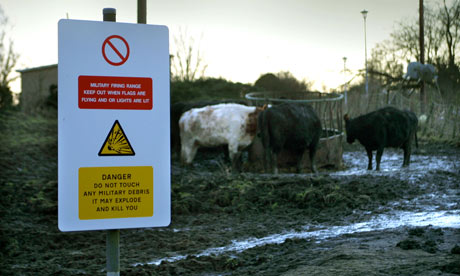 Dundrennan missile testing range, where depleted uranium ordinance was tested. The range includes farmland. Photograph: Murdo Macleod for the Guardian
The armed forces minister has been forced to apologise over misleading statements he made regarding the legality and dangers of depleted uranium weapons.
Nick Harvey admitted that he had inadvertently misled MPs about a Ministry of Defence review that he said had concluded the weapons were permissible on humanitarian and environmental grounds under the Geneva conventions.
It subsequently emerged that the review had never happened, and Harvey has apologised for the error, which he said had been made "in good faith". He has ordered that a review into the weapons' legality be carried out by civil servants. The department is facing calls for the weapons to be suspended until it is completed.
The revelations come as a cross-party campaign is launched to pile pressure on the MoD to phase out the use of depleted uranium (DU). The tank shells that depend on it have to be renewed in 2013.
DU is a chemically toxic and radioactive heavy metal produced as waste by the nuclear power industry that is included in weapons because it is an extremely hard material capable of piercing armour. Once the frontline has moved on, however, it can contaminate the environment, and has been linked to health problems in civilian populations.
The British army fired shells containing 2.3 tonnes of DU during the Gulf wars in 1990-91 and 2003. DU is used to harden 'Charm3' armour-piercing shells carried by British Challenger tanks.
In 1998 the UK government ratified additional protocol 1 of the Geneva conventions. Article 36 of that requires that all weapons are subject to a legal review to assess whether they are "capable of being used discriminately", or cause "widespread and severe damage to the natural environment".
In the past few years anti-DU campaigners have repeatedly been assured by the MoD that DU weapons had undergone such a review and been cleared. Most recently, on 10 October, Harvey wrote to the Labour MP Katy Clark saying that "the conclusions of the original legal weapons review on Charm3 are extant", and that "DU can be used within weapons".
But when Clark then asked to see the review, Harvey said it did not actually exist. "A subsequent search of departmental records has failed to find any such review," he told her on 26 October. "Though incorrect, the statement in my letter was made in good faith on the advice of officials, and I apologise for the error."
Harvey added: "In the circumstances, and given the concerns that have been expressed over DU, I have directed that a legal review should be carried out to establish the position clearly."
Clark accused the MoD of misleading the public, and demanded a public apology. "Compliance with the Geneva conventions has been used to reassure people on the legality of DU weapons, however no review has taken place to ensure that the munitions used by UK armed forces meet the conventions' criteria," she said. "I am pleased that the government has stated that a review will now take place and believe it should use this opportunity to carry out a detailed study into the long term impact of DU use."
Clark is one of the sponsors of an early day motion in the House of Commons calling on ministers to stop using DU weapons before Charm3 expires in 2013. The motion is backed by other Labour, Liberal and nationalist MPs, as well as the Conservative MPs Peter Bottomley and Zac Goldsmith.
Aneaka Kellay from the Campaign against Depleted Uranium, called for Charm3 to be immediately removed from service until its risks had been legally reviewed. "We find it extremely disappointing that the MoD has misled parliamentarians and the public," she said. "It seems bizarre that, given the long history of justified concerns over the potential health and environmental impact of these weapons, assessing whether they may be illegal was not prioritised before they entered service."
The MoD argued that it did not need to review weapons that predated its ratification of the Geneva protocol in 1998. But campaigners pointed out that Charm3 entered into service in 1999 as a modification of an earlier DU shell.
According to Prof Manfred Mohr, from the International Coalition to Ban Uranium Weapons, munitions should be subject to a legal review when they are modified. "It is therefore surprising that the UK failed to adequately review the legality of Charm3," he said.
According to Prof Manfred Mohr, from the International Coalition to Ban Uranium Weapons, munitions should be subject to a legal review when they are modified. "It is therefore surprising that the UK failed to adequately review the legality of Charm3," he said.
The MoD made clear it would continue to retain its DU capability and was "considering options" for renewing the Charm3 propelling charges in 2013. But because of "public concerns" it had begun a legal review. "The use of depleted uranium within weapons is not prohibited under international agreements," said a spokeswoman. "Until the review concludes, our position remains unchanged."
giovedì 10 novembre 2011
Fukushima: They Knew
Fukushima: They Knew
Thursday, November 10, 2011
"Completely and Utterly Fail in an Earthquake"
The Fukushima story you didn't hear on CNN
by Greg Palast
for FreePress.org
I've seen a lot of sick stuff in my career, but this was sick on a new level.
Here was the handwritten log kept by a senior engineer at the nuclear power plant:

"Utterly fail during an earthquake." And here in Japan was the quake and here is the utter failure.
The warning was in what the investigations team called The Notebook, which I'm not supposed to have. Good thing I've kept a copy anyway, because the file cabinets went down with my office building ....
WORLD TRADE CENTER TOWER 1, FIFTY-SECOND FLOOR
NEW YORK, 1986
[This is an excerpt in FreePress.org from Vultures' Picnic: In Pursuit of Petroleum Pigs, Power Pirates and High-Finance Fraudsters, to be released this Monday. Click here to get the videos andthe book.]
Two senior nuclear plant engineers were spilling out their souls and files on our huge conference table, blowing away my government investigations team with the inside stuff about the construction of the Shoreham, New York, power station.
The meeting was secret. Very secret. Their courage could destroy their careers: No engineering firm wants to hire a snitch, even one who has saved thousands of lives. They could lose their jobs; they could lose everything. They did. That’s what happens. Have a nice day.
On March 12 this year, as I watched Fukushima melt, I knew: the "SQ" had been faked. Anderson Cooper said it would all be OK. He'd flown to Japan, to suck up the radiation and official company bullshit. The horror show was not the fault of Tokyo Electric, he said, because the plant was built to withstand only an 8.0 earthquake on the Richter scale, and this was 9.0. Anderson must have been in the gym when they handed out the facts. The 9.0 shake was in the middle of the Pacific Ocean, 90 miles away. It was barely a tenth of that power at Fukushima.
I was ready to vomit. Because I knew who had designed the plant, who had built it and whom Tokyo Electric Power was having rebuild it: Shaw Construction. The latest alias of Stone & Webster, the designated builder for every one of the four new nuclear plants that the Obama Administration has approved for billions in federal studies.
But I had The Notebook, the diaries of the earthquake inspector for the company. I'd squirreled it out sometime before the Trade Center went down. I shouldn't have done that. Too bad.
All field engineers keep a diary. Gordon Dick, a supervisor, wasn’t supposed to show his to us. I asked him to show it to us and, reluctantly, he directed me to these notes about the “SQ” tests.

This much is clear from his notebook: This nuclear plant will melt down in an earthquake. The plant dismally failed to meet the Seismic I (shaking) standards required by U.S. and international rules.
Here’s what we learned: Dick’s subordinate at the nuclear plant, Robert Wiesel, conducted the standard seismic review. Wiesel flunked his company. No good. Dick then ordered Wiesel to change his report to the Nuclear Regulatory Commission, change it from failed to passed. Dick didn’t want to make Wiesel do it, but Dick was under the gun himself, acting on direct command from corporate chiefs. From The Notebook:
Wiesel was very upset. He seemed very nervous. Very agitated. [He said,] “I believe these are bad results and I believe it’s reportable,” and then he took the volume of federal regulations from the shelf and went to section 50.55(e), which describes reportable deficiencies at a nuclear plant and [they] read the section together, with Wiesel pointing to the appropriate paragraphs that federal law clearly required [them and the company] to report the Category II, Seismic I deficiencies.
Wiesel then expressed his concern that he was afraid that if he [Wiesel] reported the deficiencies, he would be fired, but that if he didn’t report the deficiencies, he would be breaking a federal law. . . .
The law is clear. It is a crime not to report a safety failure. I could imagine Wiesel standing there with that big, thick rule book in his hands, The Law. It must have been heavy. So was his paycheck. He weighed the choices: Break the law, possibly a jail-time crime, or keep his job.
What did Wiesel do? What would you do?
Why the hell would his company make this man walk the line? Why did they put the gun to his head, to make him conceal mortal danger? It was the money. It’s always the money. Fixing the seismic problem would have cost the plant’s owner half a billion dollars easy. A guy from corporate told Dick, “Bob is a good man. He’ll do what’s right. Don’t worry about Bob.”
That is, they thought Bob would save his job and career rather than rat out the company to the feds.
But I think we should all worry about Bob. The company he worked for, Stone & Webster Engineering, built or designed about a third of the nuclear plants in the United States.
From the fifty-second floor we could look at the Statue of Liberty. She didn’t look back.
***
Greg Palast is the author of Vultures' Picnic: In Pursuit of Petroleum Pigs, Power Pirates and High-Finance Carnivores, which will be released on November 14 by Penguin USA.
Iscriviti a:
Post (Atom)
-
Gli Isotopi Dimenticati: Perché Xe, Kr e Nb meritano più attenzione nei rilasci nucleari di Marco Saba Nel dibattito pubblico sui rischi n...
-
Denuclearize or lose our species: Multigenerational effects of exposure to radiation http://www.veteranstoday.com/2014/10/23/denucleariz...
-
Incidenti Nucleari Tenuti Nascosti al Pubblico: Una Serie di Segreti Radioattivi Introduzione: Il Nucleare tra Potere e Silenzio L'ene...

