The Human Consequences of the Fukushima Dai-ichi Nuclear Power Plant Accidents
http://japanfocus.org/-Eiichiro-Ochiai/4382/article.html
The Asia-Pacific Journal, Vol. 13, Issue. 38, No. 2, September 28, 2015
Eiichiro Ochiai
When a very strong earthquake (magnitude 9.0) hit the Pacific ocean side of the northeastern part of the main island of Japan on March 11th (3.11) 2011, the accompanying huge tsunami wiped out many communities along the coast. Close to 20,000 people lost their lives, mainly due to the tsunami. Many who were stripped of their homes and livelihood continue to struggle to recover their ways of life.One of the most disastrous results of the quake/tsunami was the devastation at the Fukushima Dai-ichi Nuclear Power Plant (Fk-1) of the Tokyo Electric Power Co (TEPCO). The plant is known in Japan as Fk-1 (Fuku-ichi). It released an enormous amount of radioactive material. Its effects on living organisms have already begun to be felt in many ways, though it’s been only four and a half year[s]. It may, however, be premature to make a judgment as to the degree of disaster, in light of the fact that the after-effects of the Chernobyl accident of 1986 are still unfolding.
This article discusses some prominent features of the current situation (as of August 2015) in the aftermath of the Fk-1 accident.
The Fukushima Nuclear Power Plant Accident
Four of the six reactors (units 1~4) on the premises of the Fk-1 plant experienced serious accidents including explosion, while the other two reactors (5 and 6) were not in operation and remained intact, as they are located slightly apart from the others.
Units 1~3 were operating at the time, but shut down automatically when the quake hit. The shutdown reactors need to be continuously cooled, because the fuel rods, though out of fission reaction, release great heat due to the nuclear decaying process of radioactive fission products. The quake caused substantial damage to the reactors, and the cooling systems of units 1~3 did not function properly due to both physical damage and human errors. As a result, the fuel rods in units 1~3 “melted down”.
Water added from outside for cooling purposes reacted with the hot rods to form hydrogen gas. The resulting hydrogen explosion in unit 1 stripped the roof on March 12th. Unit 2 showed no apparent damage, but released an enormous amount of radioactive material through holes created by the quake, mostly on March 15 and thereafter. The explosion at unit 3 on March 14 was most damaging. TEPCO insists that it was also a hydrogen explosion, but many observers offered different opinions, including one that it a small-scale nuclear fission explosion occurred. Unit 4 had no nuclear fuel rod in the reactor, though a large number of spent as well as new fuel rods were in its storage pool. It exploded also, its cause unknown, though TEPCO speculated that hydrogen gas entered from the adjacent unit 3, and exploded.
Release of Radioactive Material from Fk-1
A large amount of radioactive material was released as a result of the accidents. How did it happen? Leakage through cracks and holes made by the quake on some reactors, explosions, intentional vents to relieve pressure, and leakage of cooling water which is contaminated as a result of contact with the melt fuel rod debris.
The amount of radioactive material cannot be determined accurately, and can only be estimated by various means. TEPCO made an estimate of the released amounts of several tens of radioactive nuclides based on the readings of several monitoring posts placed on the premise 1. The initial governmental data 2 were based on these estimates. Some of the official data are presented in Table 1. The government’s assessment of the scale of the release from Fukushima, based on these data, was that the radiation release was relatively small compared to that of Chernobyl (April, 1986 in Ukraine), about one tenth to at most one third.
But these data accounted for only the release into the atmosphere. Radioactive materials were also released into the water systems surrounding the facilities, as well as directly into the ocean. When the amounts released into the water and the ocean were estimated 3, the total amounts released were re-calculated 4. They are shown in Table 1 along with the official data. The ratio of the amount released from Fukushima to that from Chernobyl ranges from 1.2 to 3.1 for the major nuclides, suggesting that the extent of radiation release from Fukushima was very likely more than that from Chernobyl; perhaps more than twice if all were taken account of.
Table 1. The amount of radioactive nuclides released from the Fk-1 accident (2011) compared with those released from the Chernobyl accident (1986)
|
nuclide |
Quantity in reactors at Fukushima at the time of accidenta |
The official released amount from Fukushimaa |
Total amount released from Fukushimab |
Total amount released from Chernobylc |
Fukushimab over Chernobylc |
|
Kr-85 |
8.37E+16 |
8.37E+16 |
|||
|
Xe-133 |
1.20E+19 |
1.1E+19 |
1.20E+19 |
6.5E+18 |
1.85 |
|
I-131 |
6.01E+18 |
5.0E+17 |
2.08E+18 |
1.76E+18 |
1.18 |
|
Cs-134 |
7.19E+17 |
1.8E+16 |
1.65E+17 |
5.4E+16 |
3.06 |
|
Cs-137 |
7.00E+17 |
1.5E+16 |
1.59E+17 |
8.5E+16 |
1.87 |
|
Sr-89 |
5.93E+18 |
2.0E+15 |
7.31E+16 |
1.15E+17 |
0.636 |
|
Sr-90 |
5.22E+17 |
1.4E+14 |
8.49E+15 |
1.0E+16 |
0.849 |
|
Pu-238 |
1.47E+16 |
1.9E+9 |
1.91E+10 |
3.5E+13 |
0.00055 |
|
Pu-239 |
2.62E+15 |
3.2E+9 |
3.14E+9 |
3.0E+13 |
0.00011 |
|
H-3 |
3.40E+15 |
Radioactive materials are still continuously coming out; and the data shown in the table do not take account of them. For example, Fig. 1 shows the radiation levels (Bq/L) of Cs-134, Cs-137, Sr-90, H-3 and all beta sources found in one of the drainage systems in the facility, which drained out into the ocean between April 2014 and Feb 2015 6. The amounts leaked out through drainage systems are given in Table 2 6. Substantial amounts continue to leak out. The main reason is that 300 tons of cooling water is being added daily to keep the fuel rod debris cold. That cooling water is immediately contaminated, and leaks out as a number of gaps/holes were created by the quake, though an effort has been made to contain and store it in tanks. Eventually TEPCO hopes to decontaminate the water collected, and return it to nature. How successfully decontamination procedures are being carried out is not known. There are other sources of water. One is subterranean water, which flows through the premises, particularly under the contaminated buildings. This has not yet been halted.

Fig. 1. Radioactivity of K-drain system in Fk-1 premises
|
|
Table 2 Leaked amount of radioactive material through drainage systems in Fk-1 premises
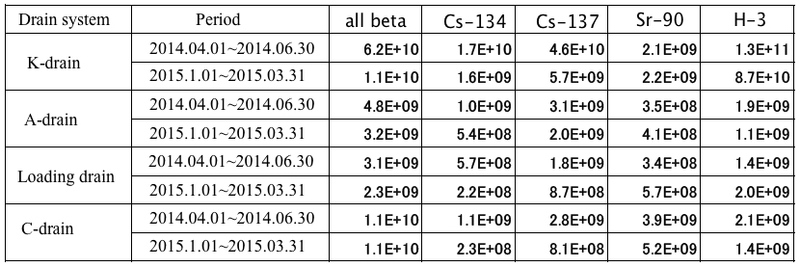 |
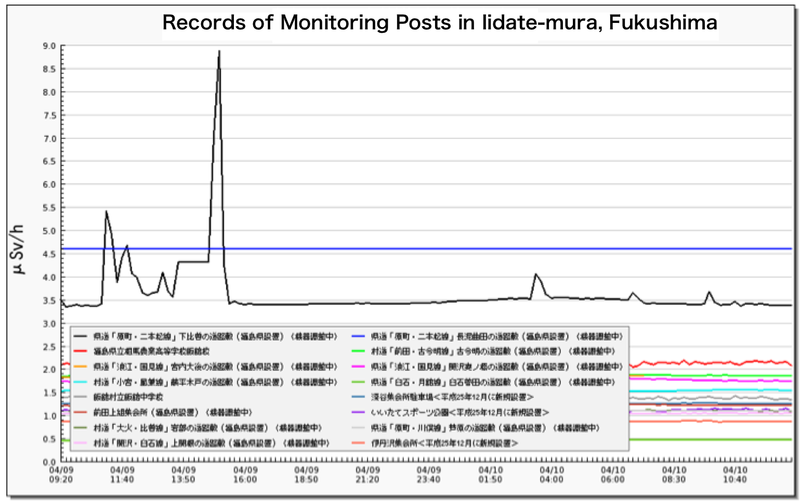
Fig. 2. Spikes observed in a monitoring post in Iidate-mura, Fukushima
|
All these events suggest that the accidents are “far from contained”, and radioactive materials are still leaking out. In sum, the overall radioactive materials released from the Fk-1 accidents are already larger than that of Chernobyl and will increase further unless measures are taken to stop these leakages.
Distribution of Radiation Levels
How far and how widely the radioactive materials are dispersed, i.e., the radiation levels at various locations, are constantly monitored not only by officials as mentioned above, but also by civil activists. Unfortunately the official data may not be reliable, as many observers have noticed. Civil activists have compared the monitoring values with their own readings and found the monitor readings lower by as much as 50% at many locations. The structure of the monitor itself often prevents the true reading of radiation. It has been pointed out, for example, that a metal plate placed just under the measuring device shields radiation coming from below 8.
A monitor placed by the government reads the so-called spatial dose; i.e., the supposed external exposure dose at 1 meter above the ground. The radioactivity is measured in terms of Bq and, if equipped, the energy value of the radiation measures is combined to indicate the spatial dose value, expressed often in terms of μSv/hr. Most monitors can measure only γ-radiation, and many monitors as well as Geiger counter type instruments measure only cpm (counts per minute), convert it to Bq values, which are converted to Sv values assuming that radiation is due to cesium (Cs-137). Cs-137 has a relatively long half-life of 30 years and is produced in a significant quantity in the fission reaction. The spatial dose is due to many other nuclides such as strontium (Sr)-89/90, tritium (H-3) and iodine (I)-129/131, but the contribution from these and other nuclides is not taken account of, or rather is counted as Cs-137. It is a sort of measure of radiation level, but does not represent the true exposure dose. However, this value is commonly used in assessing the danger level due to radiation.
A few readings will be cited here to illustrate the typical radiation levels given by the government. Some readings at monitoring posts on March 31, 2015 were: 6~10.5 μSv/hr in Hutaba-cho where Fk-1 is located, 4~17 mSv/h in Okuma-cho, just south of Hutaba (several km from Fk-1) and 1.7~3.6 μSv/hr in Tomioka-cho, south of Okuma (i.e, 10 km south of Fk-1). These are readings in highly contaminated areas.
On April 14, 2015 when a plume seemed to have been released, several readings (except the spike, which was a sudden rise to twice or higher level) were: 0.03~0.04 μSv/hr in Hokkaido (northernmost island); 0.02~0.05 μSv/hr in Aomori; 0.02~0.05 μSv/hr in Iwate; 0.04~0.12 μSv/hr in Miyagi (just north of Fukushima); 0.14~0.30 μSv/hr in Soma city, Fukushima; 0.05~0.12 μSv/hr in Tochigi; 0.08~0.09 μSv/hr in Tokyo; 0.03~0.06 μSv/hr in Kyoto; 0.05~0.08 μSv/hr in Hiroshima; 0.04~0.06 μSv/hr in Fukuoka.
These are recorded on the monitoring posts, but many places are not covered by monitoring posts, where much higher radiation levels have been recorded; i.e., “hot spots”. Recently reported examples were: 1.23 μSv/hr in western Tokyo on July 23, 2.92 μSv/hr in Saitama on July 25, 4.8 μSv/hr in Iwaki (30 km south of Fk-1) on Aug. 2 9.
Let’s assume that you are standing on a location where the monitoring post showed 0.1 μSv/hr throughout a whole year. Then, you will be exposed to 0.9 mSv/year (0.1 μSv/hr x 24 hrs x 365 days=876 mSv/year=0.9 mSv/y). The Japanese government calculates the dose per year by assuming that one would stay in open areas for 8 hrs and for the rest of the day in buildings, where the radiation level is assumed to be about 40% of the outside. This calculation would make the exposure dose significantly lower than the real value; in the example above, it would be 0.54 mSv/year. This assumption is arbitrary, indeed, the inside of a building has often been found to have radiation levels as high as that of the immediate outside.
The official exposure dose allowed is currently set as 1 mSv/year (see note at the end). This corresponds to a dose rate of 0.18 μSv/hr according to the governmental way of calculation. It is further degraded to 0.23 μSv/hr with some other arbitrary assumptions, and this value is regarded as the permissible level of dose rate. So dose rate below this value is supposed to be OK. If you are exposed directly to this level for a year, then your accumulated dose will be 2 mSv/year. In other words, the government limit of 1 mSv/year is actually close to 2 mSv/year in reality. The government is currently trying to raise the 1mSv/year limit to 20 mSv/year. If 20 mSv/year is approved and people are forced to return to their previous homes under this condition, they will be exposed to dangerously high levels of radiation. It must be pointed out, though, that there is no safe level.
Radioactive iodine affects the thyroid immediately. Iodine-131 is short-lived with a half-life of 8 days, and I-129 has a very long half-life of 15.7 million years. Both would be readily absorbed into the thyroid gland, as iodine is used to make thyroid hormones. In the nuclear reactor, both are produced in comparable amounts, but I-131 affects the thyroid more seriously. An entity with a shorter half-life emits radiation more often than that with a longer half-life in the same chemical quantity. The distribution of I-131 in the environment is difficult to determine accurately, as it is short-lived.
In Dec. 2014, the official nuclear regulatory committee (Japan) published a report to indicate that Fk-1 is still emitting I-131 and other I-radioisotopes 10. According to their report, trans-uranium Cm-242 and other such nuclides were formed in the fuel rods during the operation, and they fission spontaneously, as a result producing radioactive nuclides including I-131. The possible maximum amount of I-radioisotopes released from this source has been estimated as 28 mSv/week (=170 μSv/hr) in terms of equivalent dose for child thyroid at the border of the premises of Fk-1 10.
An alternative expression of contamination is the radioactivity of soil, typically Bq value per kg of soil, which often is converted to Bq/m2. It is assumed that the density of soil is 1.3 g/cm3 and that the radioactive material exists in the uppermost 5 cm of the soil, so that Bq/m2 value is 65 x the value in Bq/kg. This value (Bq/kg) is real, measured directly by an instrument on a sample of soil. Hence this may be more reliable in expressing the level of contamination than the spatial exposure dose. Besides, the source of radiation (from a soil sample) can be readily identified. This is not sufficient, however, as minute radioactive particles can be floating above the soil, which can be measured as spatial radiation.
In all these expressions, a fundamental uncertainty is that radiation levels may not be constant over time. Radioactive material decays over time and can move due to water flow or wind. Therefore, radiation levels have to be monitored continuously.
It must be pointed out that the external exposure dose level obtained from measurements of this kind (i.e., spatial dose and soil contamination) is less important than the internal exposure dose, which is not necessarily related to the external dose. The significance of internal exposure will be outlined below. The only thing that can be said here is that people living in a place of higher spatial dose level and/or higher soil contamination would have a higher risk of being exposed internally; but there is no proven direct correlation, and cannot be.
The more serious factor, internal exposure, is supposed to be measured by the whole body counter. But it can measure only g-radiation, and cannot measure the more serious a- and b-radiation. Besides, it measures only the radiation coming out of a body at the time of the test, and cannot determine the more meaningful accumulated exposure dose. Hence whole body counter results can only be used to give a tested person mental relief in cases where the reading is low or non-detectable. But, even that could be dangerous, if the source inside is emitting a and/or b radiation.
Reality of Internal Exposure
The effects of radioactive fallout from an accident of a nuclear power reactor as well as a nuclear bomb explosion are caused mostly by “internal exposure”, yet no adequate attention has been given to this aspect by the authorities and the associated scientists. The sources of the internal exposure are minute radioactive particles floating in the air, which can be inhaled, and contaminated food and drinks consumed. Radioactivity of foods and drinks produced in the contaminated area is monitored, and those with activity higher than the regulation values cannot legally be marketed.
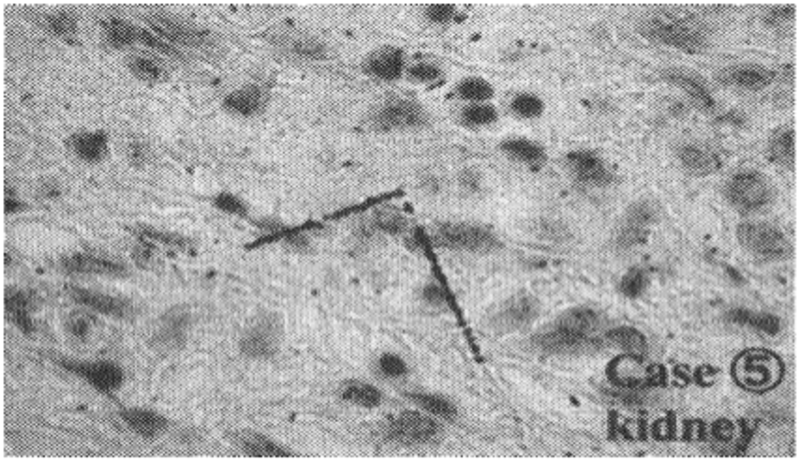
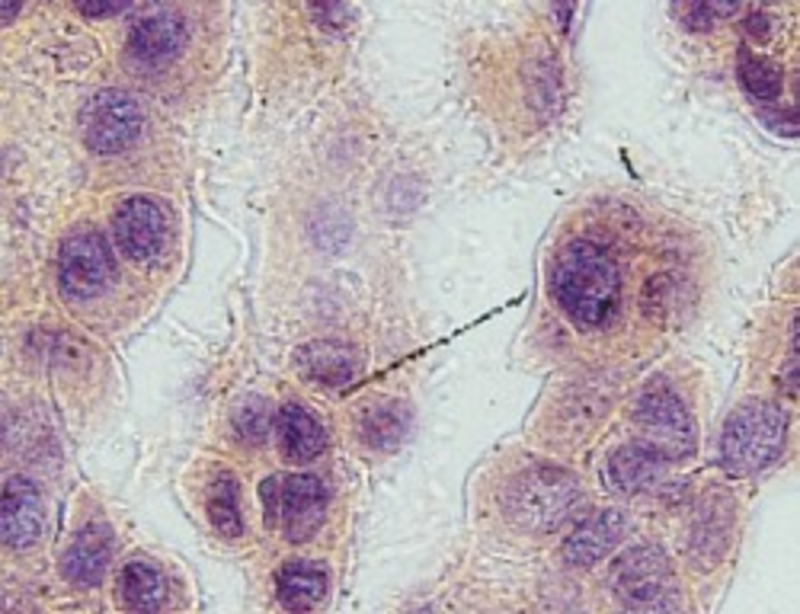
One cannot well safeguard against ingesting radioactive material, unless one measures the radioactivity of everything one takes in, which is not possible. The issue of “internal exposure” is complicated, and would require another detailed article. For now, three photographs are shown below to illustrate the reality of internal exposure.
Figs. 3 and 4 are the trace of a-particles in the preserved tissues of victims of the atomic bomb explosions in Hiroshima and Nagasaki. It is not easy technically to take this kind of photo, and scientists succeeded in doing so only recently (11, 12). The source of the first trace is plutonium from the Nagasaki bomb, and that of the second is uranium from the Hiroshima bomb. The plutonium and uranium embedded in the tissues of atomic bomb victims are still emitting a-radiation after 70 years. This says that the fallout of the atomic bomb explosions, which included uranium in the Hiroshima bomb and plutonium in the Nagasaki bomb, somehow got into the body of the victims and stuck in those tissues, and emitted and destroyed the surrounding tissues for 70 years. Both plutonium and uranium have a long half-life, millions of years or more.
 |
 |
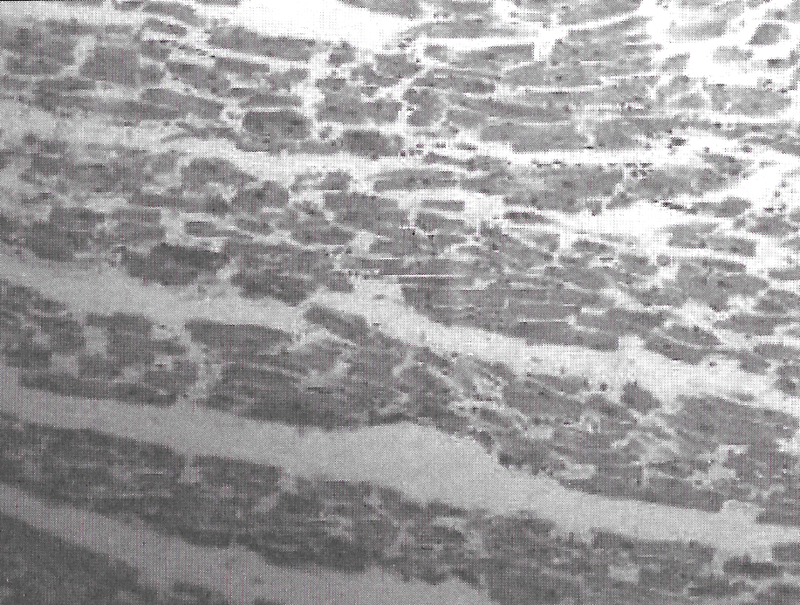 |
| Fig. 3. a-Particles travel straight even in tissues. The linear traces are those emitted by plutonium in the preserved kidney tissues of an A-bomb victim in Nagasaki (70 years ago) 11 | Fig. 4. A trace of a-particle of uranium in the lung tissue of a Hiroshima victim 12 | Fig. 5. The heart muscle fibers are broken in the heart of a man (43 years old) who died of heart disease in the most contaminated area (Belarus) of the Chernobyl accident 13 |
Fig. 5 shows the heart muscle fibers of a victim of the Chernobyl accident 13. They are broken at many places. Likely the b and g radiation from Cs-137 (and others) damaged the fibers by breaking the chemical bonds. The traces of b and g cannot be visualized in such samples.
Thyroid Cancers among Children in Fukushima
The authorities, such as ICRP and IAEA, have acknowledged that thyroid cancers in children can be caused by radiation, likely due to I-131. They have also recognized the causal relationship between leukemia and radiation. But they deny a causal relationship in the case of other cancers and other diseases, despite the fact that many studies and reports have shown that all sorts of disease including cancers can be caused by radiation.
The rate of thyroid cancer is very low among children (those under 18 years) under normal circumstances; 1 or 2 per million children per year. Fukushima prefecture started to investigate abnormalities in the thyroid gland in children (under 18 years old) in 2011. Soon they found high rates of abnormalities: nodules, cysts, and then tumors mostly malignant. By the spring of 2015 they have counted 126 thyroid cancer cases (mostly papillary) among 370,000 children in Fukushima 14. This rate amounts to 340/1,000,000 over 4 years, i.e., 85/1,000,000/year. This is abnormally high, approximately 60 times the normal rate, even much higher than that reported in Chernobyl.
Yet, the authorities and the committee in charge of this investigation have denied causality to radiation from Fk-1 accidents. They argued against causality thus:
(a) Screening effects, that is, they used sophisticated techniques to show that cancers that are ordinarily non-detectable were detected. However, officials admitted recently that screening effects would not be able to explain such a high rate 15.
(b) In the case of Chernobyl thyroid cancers in children appeared only 4 years after the accident. It is too early for Fukushima children to get thyroid cancers. This argument has been rebutted by an article published in the Asia-Pacific Journal: Japan Focus 16.
(c) They checked a few other places in Japan, and say that the thyroid cancer rate in Fukushima is similar to that found in Aomori, Nagasaki and Yamanashi 17. They imply that Fukushima is not abnormal. This study is based on a very small sample in which only one cancer was found; hence the result is not statistically meaningful.
(d) It is too soon for thyroid cancers to appear. It usually takes four to five years. This is in addition to the argument of comparison with Chernobyl (b) above. Hence the cancers found here should have started before the accidents.
(e) The amount of radioactive material released was far lower than that of Chernobyl, and hence would not have such effects as those found in Chernobyl.
A recent report 18 indicates that the latent period for thyroid cancer can be as short as one year in children. The amount of radioactive material released (e) has been discussed earlier, and has been shown to be at least as high as, or even higher than, that of Chernobyl. All of these arguments by the authorities are based on weak or incorrect information.
Careful studies of the relationship between the locations where children who got thyroid cancer live and the radiation distribution have revealed correlations, though these are not perfect. A correlation obtained by an analysis is shown in Fig. 6 19. This indicates a likely causality; i.e., radiation caused the thyroid cancers, though the dose used here does not necessarily represent an accurate value of I-131 but rather a general radiation level. Thyroid cancers are increasing among adults, too. As seen in Table 4, the increase over 2010-2013 was more than 200 % in Fukushima as well as in adjacent prefectures: Ibaragi, Gunma and Tochigi.

Fig. 6. Pediatric thyroid cancer rate vs spatial
exposure rate for different areas in Fukushima prefecture. The line is
the linear regression line. R2 implies that the line accounts for 54% of
the variance in thyroid cancer rate due to radiation.
|
Other Diseases are also Increasing in Fukushima since the Accident
No systematic investigation has been published officially on the health effects of radiation as a result of the Fukushima accident. However, some statistical data may be indicative of significant trends. All indications are that incidence of many diseases is increasing not only in Fukushima but also all over Japan.
Table 3 shows the number of diagnosed cases recorded at Fukushima (prefectural) Medical School Hospital (latest published data based on ref. 20). Cancer of the small intestine, which is normally rare, increased by 400% in two years. Eye disease (cataract), brain, heart disease (angina) and all kinds of cancer have increased. Many diseases other than those listed in the table have also increased since the Fk-1 event.
Table 3. Increase in diseases since the accidents: records at the Hospital of Fukushima (prefectural) Medical School
|
Disease |
2010 |
2011 |
2012 |
|
cataract |
150 (100%) |
344 (229%) |
340 (227%) |
|
angina |
222 (100%) |
323 (145%) |
349 (157%) |
|
bleeding in brain |
13 (100%) |
33 (253%) |
39 (300%) |
|
lung cancer |
293 (100%) |
504 (172%) |
478 (163%) |
|
esophagus cancer |
114 (100%) |
153 (134%) |
139 (122%) |
|
stomach cancer |
146 (100%) |
182 (125%) |
188 (129%) |
|
cancer in small intestine |
13 (100%) |
36 (277%) |
52 (400%) |
|
colon cancer |
31 (100%) |
60 (194%) |
92 (297%) |
|
prostate cancer |
77 (100%) |
156 (203%) |
231 (300%) |
|
shortened pregnancy period + low birth weight |
44 (100%) |
49 (114%) |
73 (166%) |
Radioactive materials do not stop at the border of Fukushima prefecture. They have spread beyond Fukushima as noted earlier. Accordingly, health effects could be observed in other prefectures, as well. Indeed this turned out to be the case. Unfortunately, no systematic studies of cities or prefectures have been published yet. However, every hospital publishes its activities listing the number of patients with different diseases, the number of surgeries, etc. These data may be indicative of larger patterns in Japan.
The following tables are based on such accounts; collecting data for all hospitals that reported data. They include published data from all prefectures 21. The tables list such data for Fukushima and the surrounding prefectures (Tochigi, Gunma, Ibaragi, Yamagata, Miyagi), the next nearest prefectures (Saitama, Chiba, Tokyo, Kanagawa), and several major prefectures further away (Aichi, Osaka, Fukuoka, Hokkaido and Okinawa).
In three years since the accident, many diseases increased by 40-50% as shown in tables 4-6. These tables were constructed on the basis of collections of data from hospitals across Japan 21. The incidence of thyroid cancer, which is the most sensitive indicator, more than doubled in the three years 2010 to 2013 not only in Fukushima but in neighboring Gunma, Tochigi and Ibaragi to the south of Fukushima. It increased by amounts ranging from 26 to 61 percent in all other prefectures listed below, as well. The national total rose by 42%.
Table 4. Thyroid cancers increased everywhere since the 11 March 2011 accident 21
|
prefecture |
2010 |
2011 |
2012 |
2013 |
2013/2010 |
|
Fukushima |
119 |
187 |
199 |
271 |
228% |
|
Tochigi |
116 |
218 |
211 |
235 |
203% |
|
Gunma |
108 |
124 |
185 |
350 |
217% |
|
Ibaragi |
61 |
115 |
136 |
138 |
226% |
|
Yamagata |
95 |
128 |
146 |
139 |
146% |
|
Miyagi |
248 |
343 |
378 |
399 |
161% |
|
Saitama |
203 |
226 |
306 |
301 |
148% |
|
Chiba |
260 |
340 |
410 |
352 |
135% |
|
Tokyo |
1833 |
2819 |
2874 |
2884 |
157% |
|
Kanagawa |
469 |
664 |
656 |
749 |
160% |
|
Aichi |
525 |
632 |
819 |
949 |
120% |
|
Osaka |
650 |
938 |
1048 |
1039 |
160% |
|
Fukuoka |
583 |
736 |
629 |
587 |
101% |
|
Hokkaido |
855 |
1083 |
1151 |
1227 |
144% |
|
Okinawa |
82 |
104 |
117 |
103 |
126% |
|
Japan |
10816 |
14909 |
15635 |
16023 |
148% |
Table 5. Increase of myocardial infarction 21
|
prefecture |
2010 |
2011 |
2012 |
2013 |
2013/2010 |
|
Fukushima |
507 |
622 |
668 |
675 |
133% |
|
Tochigi |
722 |
878 |
1014 |
977 |
135% |
|
Gunma |
538 |
710 |
797 |
821 |
153% |
|
Ibaragi |
700 |
948 |
1077 |
1212 |
173% |
|
Miyagi |
598 |
718 |
831 |
901 |
151% |
|
Saitama |
1873 |
2465 |
2733 |
2752 |
147% |
|
Chiba |
1447 |
2008 |
2558 |
2604 |
135% |
|
Tokyo |
3680 |
4849 |
5581 |
5605 |
180% |
|
Kanagawa |
2361 |
2871 |
3421 |
3657 |
155% |
|
Aichi |
2212 |
2877 |
3158 |
3287 |
149% |
|
Osaka |
2335 |
3224 |
3648 |
3652 |
156% |
|
Fukuoka |
1533 |
1996 |
2326 |
2285 |
149% |
|
Okinawa |
437 |
572 |
537 |
669 |
153% |
|
Japan |
35411 |
46109 |
51947 |
53400 |
151% |
Table 6. Acute leukemia is also increasing 21
|
Prefecture |
2010 |
2011 |
2012 |
2013 |
2013/2010 |
|
Fukushima |
108 |
97 |
79 |
230 |
213% |
|
Tochigi |
363 |
418 |
340 |
322 |
89% |
|
Gunma |
113 |
178 |
267 |
350 |
310% |
|
Ibaragi |
251 |
309 |
351 |
324 |
129% |
|
Yamagata |
121 |
117 |
172 |
135 |
112% |
|
Miyagi |
191 |
236 |
199 |
241 |
126% |
|
Saitama |
266 |
336 |
590 |
757 |
285% |
|
Chiba |
449 |
430 |
529 |
576 |
128% |
|
Tokyo |
1770 |
2135 |
2366 |
2342 |
132% |
|
Kanagawa |
686 |
1024 |
964 |
1062 |
155% |
|
Aichi |
895 |
1138 |
1208 |
1178 |
132% |
|
Osaka |
869 |
1210 |
1393 |
1623 |
187% |
|
Fukuoka |
686 |
755 |
722 |
767 |
112% |
|
Hokkaido |
449 |
628 |
728 |
830 |
185% |
|
Okinawa |
101 |
111 |
111 |
110 |
109% |
|
Japan |
12820 |
15498 |
17015 |
18167 |
142% |
This could be only the beginning of further serious developments in time. The radiation effects are likely to increase with time. In particular, various solid cancers have relatively long latent periods. They increase after 10 years or later as seen among atomic bomb survivors in Hiroshima and Nagasaki 22.
Concluding Remarks
The Japanese government under Democratic Party rule, declared that the Fukushima accident was over at the end of 2011, and the prime minister in Sept 2013 under the Liberal-Democratic Party at the IOC meeting to select the next Olympic site pronounced that the Fukushima accident had been contained and Tokyo was well prepared for the Olympics.
The real situation is far different, as documented above. Leakage of radioactive materials through various routes continues. The locations and states of the melted fuel rods in the reactors at Fk-1 have yet to be determined. It was found only recently (by use of muon radiation/absorption technique) that the nuclear reactors of units 1 and 2 are indeed devoid of nuclear fuel rods in the core 23, but the technique was insufficient to locate the melted fuel rod debris.
Serious health effects of radiation in general have already been widely observed. It is best to refer to better studied examples of the past: Chernobyl 24 and down-winders of Nevada tests 25. The reality of health effects at Chernobyl due to fallout from the explosive accident as detailed in 26 and summarized in 27 may indicate the future of Fukushima and Japan.
The health effects of radiation are often slow in manifesting, particularly in the case of cancers, though cancer rates have already started to increase in Fukushima and elsewhere, as discussed above. Therefore, more people will be affected by radiation in the years to come, not only in Fukushima, but across Japan.
The health effects have been investigated by the Japanese national and local governments only with respect to Fukushima children’s thyroid abnormalities, as mentioned above. The Fukushima prefectural medical school is reportedly collecting data from all hospitals in Japan, but it has not published the data. Although still in denial of the causal relationship between children’s thyroid cancers and radiation, they finally admitted recently that the cancer rate is indeed abnormally high 15.
Radiation effects are seen not only on human health, but also on many living organisms. A butterfly species has been observed to be affected by radiation, and the effects seem to be inherited from one generation to another 27. Reproductive success of goshawks has decreased in response to higher levels of radiation 28. Many bird species are rapidly decreasing in number 29. Deserted cows have been found to be highly contaminated with cesium-137 and other nuclides 30. Deformed vegetables and fruits have been observed at many locations. These are but a few examples of radiation effects on plants and animals.
The government may be attempting to cover up the negative data it gathers. If it admits the causal relationship between serious health effects and radiation, it would be obliged to abolish the nuclear power plants or at least delay re-opening closed plants. The truth that “radiation (of high energy) is incompatible with life” 31 directly confronts humankind, yet many refuse to recognize it because the government and the nuclear industry and associated scientists in Japan and many other countries continue to suppress the data.
No single nuclear power plant has operated in Japan in the last two years, yet there has been no shortage of electricity. The Japanese government, along with the nuclear industry, has now restarted one of the fifty nuclear power reactors, despite strong opposition by the majority of Japanese and despite the high risk in Japan of further geological activity, both volcanic and earth quakes.
Note: The limit 1 mSv/year was set by the department of science and education of the Japanese government, based on a law (protection against radiation effects due to radioactive isotopes) and a recommendation by ICRP (international commission of radiological protection)
Acknowledgement: Comments and suggestions made by Drs. Anders Moller, Leonard Angles, and Mark Selden are gratefully acknowledged.
Eiichiro Ochiai was born in Japan, and educated up to the PhD in Japan. He taught and conducted research in chemistry at college/universities in Japan, the United States, Canada and Sweden. Publications include “Bioinorganic Chemistry, an Introduction” (Allyn and Bacon, 1977), “Bioinorganic Chemistry, a Survey” (Elsevier, 2008), “Chemicals for Life and Living” (Springer Verlag, 2011), and “A Sustainable Human Civilization Beyond ‘Occupy’ Movements” (Kindle, 2011).
Recommended citation: Eiichiro Ochiai, "The Human Consequences of the Fukushima Dai-ichi Nuclear Power Plant Accidents", The Asia-Pacific Journal, Vol. 13, Issue 38, No. 2, September 28, 2015.
Related articles
• Eiichiro Ochiai, The Manga “Oishinbo” Controversy: Radiation and Nose Bleeding in the Wake of 3.11
• Nakasatomi Hiroshi, After Nuclear Disaster: The decision-making of Fukushima University authorities, the threat to democratic governance and countermovement actions
• Kyle Cleveland, Mobilizing Nuclear Bias: The Fukushima Nuclear Crisis and the Politics of Uncertainty
• David McNeill, Japanese Government Squelching Efforts to Measure Fukushima Meltdown
• Yasuhito Abe, Safecast or the Production of Collective Intelligence on Radiation Risks after 3.11
• Adam Broinowski, Fukushima: Life and the Transnationality of Radioactive Contamination
• Paul Jobin, The Roadmap for Fukushima Daiichi and the Sacrifice of Japan's Clean-up Workers
• Anders Pape Møller and Timothy A. Mousseau, Uncomfortable Questions in the Wake of Nuclear Accidents at Fukushima and Chernobyl
References
Asterisked references (*) are available only in Japanese.
1 Estimate of the quantities of radioactive material released to the atmosphere from the accident of Fk-1, TEPCO, May, 2012*.
2 The state of the nuclear reactor cores of units 1~3, June 6, 2011, Nuclear safety/protection agency (Japan)*.
3 Pavel P. Povinec, Katsumi Hirose, Michio Aoyama, “Fukushima Accident ― Radioactivity Impact on the Environment,” pp. 125~127, (Elsevier (2013))
4 Yamada, K., Watanabe E., Re-evaluation of released amounts of radioactive material from Fk-1 accident: Comparison with data of Chernobyl, May, 2014*.
5 Chernobyl data are cited from ref 3, but based on several estimates including UNSCEAR; ANNEX J Exposures and effects of Chernobyl accident; see here.
6 See here*.
7 See here*.
8 See here*.
9 This kind of data is regularly reported by activists/organizations on the internet; its accuracy cannot be ascertained. It can be said only that such high spots likely exist.
10 See here*.
11 Shichijo, K., Nagasaki University*
12 Kamata, N., et al, Hiroshima University and Nagasaki University, published in June 8th edition of Mainichi newspaper*
13 Bandazhevsky, Y., “The Effects of Radioactive Cesium on the Population and its Physiological Effects”, (Japanese ed., translated from Russian by Kubota, M.), p. 65, (Godo Publ. Co. (Tokyo), 2015)
14 See here*
15 See here*; also here.
16 See here.
17 See here*.
18 See here.
19 Based on https://www.facebook.com/pages/放射能と健康被害/499769473505463(放射能と健康被害=radiation and health effects)
20 See here.
21 See here*, here*, and here*.
22 Ozasa, K., Shimizu, Y., Suyama, A., Kasagi, F., Soda, M., Grant, E. J., Sakata, R., Sugiyama, H., Kodama, K., Studies of the mortality of atomic bomb survivors, Report 14, 1950-2003: An overview of cancer and noncancer Diseases (LSS-14), Rad. Res., 177 (2012), pp. 229-243
23 Press release of Nagoya University, March 19, 2015*; Kyodo Press, March 19, 2015*
24 Yablokov, A. V., Nestrenko, V. B, Nestrenko, A. V., ”Chernobyl: Consequences of the Catastrophe for People and the Environment” (Ann. New York Acad. Sci., Vol 1181, 2009)
25 Johnson, C. J., Cancer Incidence in an Area of Radioactive Fallout Downwind From the Nevada Test Site, J. Am. Med. Assoc., 251 (1984), pp. 230-236
26 Pflugbeil, S., Claussen, A., Schimitz-Feuerhake, I., “Health Effects of Chernobyl: 25 years after the reactor catastrophe”, (IPPNW Germany (IPPNW=International Physicians for Prevention of Nuclear War), 2011)
27 Hiyama, A., Nohara, C., Kinjo, S., Taira, W., Gima, S., Tanahara, A., Otaki, M., Biological impacts of the Fukushima nuclear accident on the pale grass blue butterfly, Scientific Rept., 2 (2012), article #570
28 K. Murase, J. Murase, R. Horie & K. Endo, Effects of the Fukushima Daiichi nuclear accident on goshawk reproduction, Sci. Rep. 5:9405
29 Bonisoll-Alquati, A., Koyama, K., Tedeshci, D. J., Kitamuara, W., Suzuki, H., Ostermiller, S., Arai, E., Moeller, A. P., Mousseau, T. A., Abundance and genetic damage of barn swallows from Fukushima, Scientific Rept, 5 (2015), article # 9432.
30 See here*.
31 Ochiai, E., “Hiroshima to Fukushima: Biohazards of Radiation” (Springer Verlag (Heidelberg), 2013)


